Sleep apnoea symptoms: the signs most people miss
Obstructive sleep apnoea is a condition in which the airway repeatedly closes during sleep, interrupting breathing and fragmenting sleep dozens or hundreds of times a night. Most people who have it do not know. It develops so gradually that the tiredness feels like ageing, and many of its symptoms — needing to pass urine at night, morning headaches, reflux, low mood — look like other problems entirely.
- The obvious signs are loud snoring, witnessed pauses or gasping, and daytime sleepiness — but a large number of people have none of them.
- The missed signs include waking unrefreshed, nocturia, morning headache, dry mouth, night sweats, reflux, poor concentration and low mood.
- You do not have to be overweight or a man or elderly. Jaw and airway shape matter as much as weight, and risk rises sharply after the menopause.
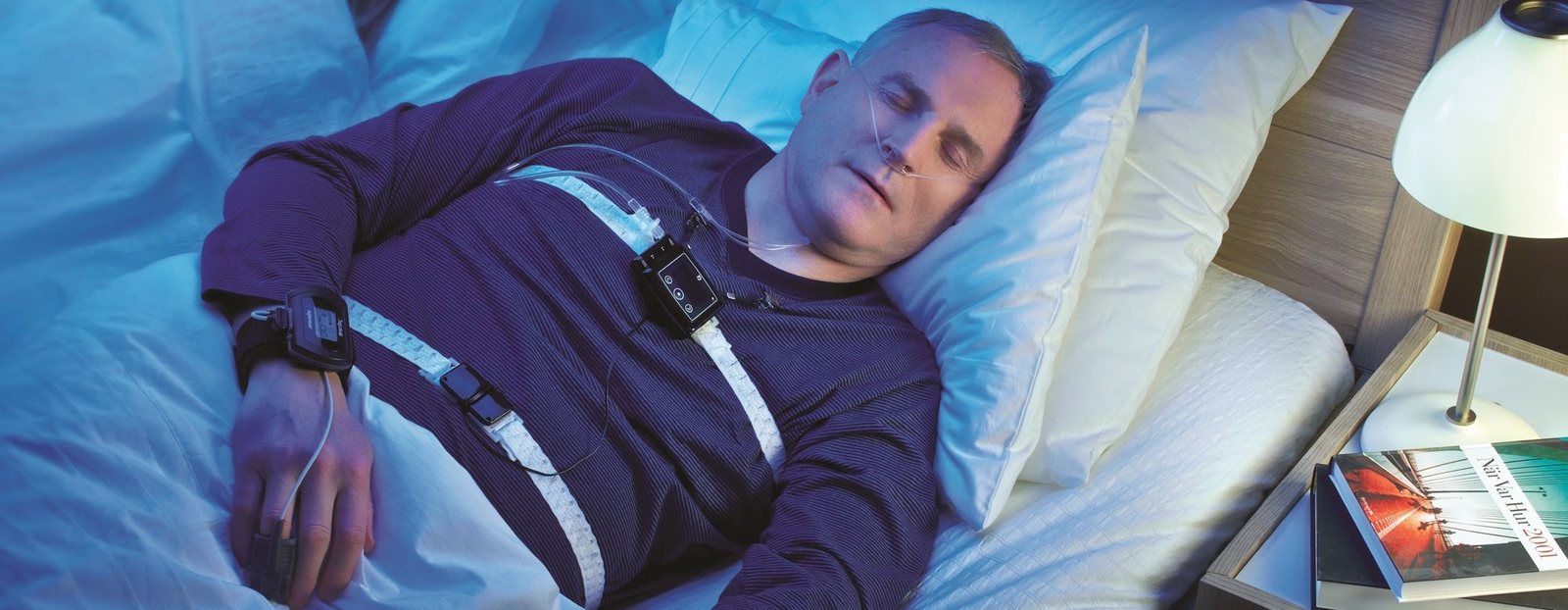
- Diagnosis needs a sleep study — questionnaires only tell you whether to test. Home studies are done in your own bed.
- Treatment is not automatically CPAP. Nasal blockage and large tonsils should be dealt with first, and positional therapy, dental devices and weight loss all have a role.
Obstructive sleep apnoea is one of the conditions I most often find in people who came to see me about something else. They arrive with fatigue that has been investigated and found to have no cause, or blood pressure that will not come down on three tablets, or low mood that has not responded properly to treatment, or blood sugars that keep creeping up despite genuine effort. In a proportion of them, the answer is that their airway is closing while they sleep.
It is worth being clear about the scale of the problem. Obstructive sleep apnoea affects in the order of four per cent of the adult population when defined conservatively, and considerably more when milder disease is included. The majority of people who have it in the UK have not been diagnosed. That is not because the condition is subtle in its effects — it is because it is subtle in its symptoms.
What obstructive sleep apnoea actually is
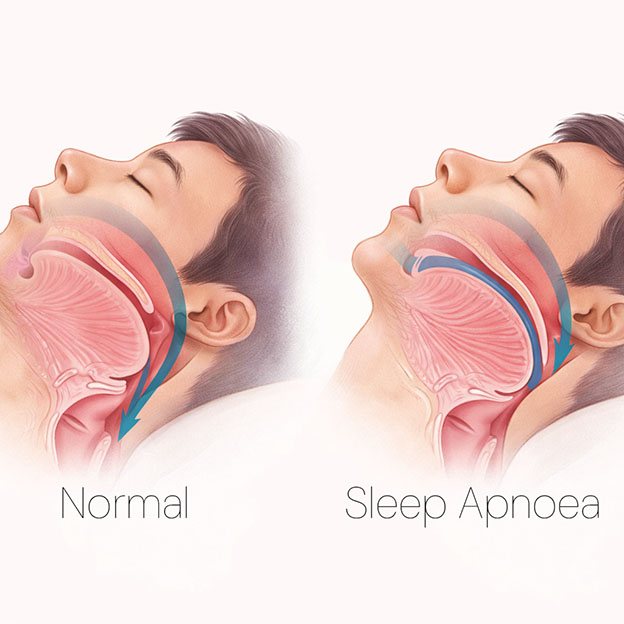
When you fall asleep, the muscles holding your throat open relax. In obstructive sleep apnoea the airway narrows so much that it closes completely, or almost completely, and airflow stops. You continue trying to breathe — the chest and abdomen keep moving, sometimes vigorously — but no air is getting through.
Oxygen levels start to fall and carbon dioxide starts to rise. After a few per cent drop in oxygen the brain intervenes, briefly lifting you out of deep sleep so that the muscles regain tone and the airway reopens. You take a deep breath, oxygen recovers, you sink back into deeper sleep — and, because the same conditions apply, the airway closes again. In severe cases this cycle repeats every thirty to sixty seconds, all night.
Almost nobody remembers any of it. The arousals are too brief to register as waking. What you experience is simply a night's sleep that does not restore you.
The symptoms everybody knows about
Three features are the ones most people have heard of, and they are worth taking seriously when present.
Loud snoring. Around nine out of ten people with obstructive sleep apnoea snore. A useful rule of thumb is whether the snoring can be heard through a closed door. What is more telling than the volume, though, is the pattern: snoring that stops abruptly, is followed by silence, and then resumes with a snort or a gasp. That interruption is the apnoea.
Witnessed pauses, gasping or choking. If a partner has seen you stop breathing, that is significant. But its absence proves nothing. Bed partners are surprisingly poor at detecting apnoeas, because many events are not dramatic — the person simply breathes more and more shallowly, goes slightly blue, then takes a couple of deeper breaths and settles again. When people see their own sleep study data for the first time, they are usually astonished at how much was going on that nobody noticed.
Daytime sleepiness. Falling asleep in front of the television, in meetings, as a passenger in a car, or — most worryingly — at the wheel. The Epworth Sleepiness Scale is used to quantify this. But a very large number of people with significant sleep apnoea score normally on it, either because they genuinely do not feel sleepy or because they have recalibrated what normal feels like over many years.
The symptoms that get missed
These are the ones that bring people to a GP under a different heading, and the ones I have learned to ask about specifically.
The nocturia is worth dwelling on, because it is so frequently investigated as something else. A hormone released by the heart, atrial natriuretic peptide, normally suppresses urine production overnight. In sleep apnoea the repeated arousals and the pressure changes in the chest disrupt this signalling, so the kidneys behave as though it were morning and the bladder keeps filling. I have met patients who had been through urology investigations and been started on prostate medication when the underlying problem was their breathing.
The mood symptoms deserve the same attention. The relationship runs in both directions — sleep apnoea contributes to depression and anxiety, and depression is itself associated with disturbed breathing in sleep. If low mood has not responded as expected to treatment, and the sleep history fits, it is worth testing.
The phrase I hear most often after successful treatment is some version of "I had completely forgotten what normal felt like." Sleep apnoea creeps up over years, and people adjust to it. That is exactly why relying on how tired you feel, as a way of deciding whether to test, is unreliable.
Who gets it — and who gets missed
The recognised risk factors are being male, being older, being overweight — particularly with a collar size above about 17 inches in men or 16 in women — having a family history, drinking alcohol in the evening, and smoking. These are real, but relying on them is precisely how the diagnosis gets missed.
Women. Sleep apnoea in women is under-diagnosed to a striking degree. Women are more likely to present with fatigue, insomnia, low mood, headache and palpitations than with classic snoring and witnessed apnoeas, and those symptoms are more likely to be attributed elsewhere. Risk rises substantially after the menopause, when the protective effect of oestrogen and progesterone on airway muscle tone is lost. If you are in your late forties or fifties, sleeping badly, and the picture has been put down to hormones, it is entirely reasonable to consider both — I have written about the overlap in what is perimenopause, and I see the two conditions together often.
People who are not overweight. Weight is a risk factor, not a requirement. Slim patients with sleep apnoea usually have an anatomical reason: a small or set-back lower jaw, a high narrow palate, crowded teeth, large tonsils, or a deviated septum. Craniofacial shape also means that in some ethnic groups significant sleep apnoea occurs at markedly lower body weights.
People who sleep alone. Without a witness, the most obvious signs simply go unreported.
Why it matters
Two mechanisms do the damage. The first is the repeated fall in oxygen, which triggers inflammation and oxidative stress. The second is the surge of adrenaline that accompanies each arousal — hundreds of times a night, the cardiovascular system receives a stress signal at a time when it should be at its most rested.
The consequences that follow are well established: high blood pressure that is often resistant to treatment, atrial fibrillation and other arrhythmias, stroke, coronary disease, type 2 diabetes and worsening glycaemic control, low mood and anxiety, and measurable cognitive impairment. There is also a substantial road safety risk — drivers with untreated obstructive sleep apnoea have roughly two to three times the crash risk of the general population, and, crucially, this impairment is present whether or not the person feels sleepy. I cover the legal side of this in driving with sleep apnoea and the DVLA rules.
The encouraging part is that most of this risk is modifiable. Effective treatment lowers blood pressure, improves glycaemic control, improves mood and concentration, and reduces crash risk by around 70%.
How it is diagnosed
Questionnaires tell you whether to test — not whether you have it
Two are used routinely. The STOP-BANG questionnaire scores eight items — snoring, tiredness, observed apnoeas, blood pressure, BMI, age, neck circumference and sex — and is a good screening tool: it identifies most people who have the condition, at the cost of also flagging some who do not. The Epworth Sleepiness Scale measures how likely you are to doze in eight everyday situations.
Neither can diagnose or exclude sleep apnoea. A normal Epworth score in particular is reassuring to nobody — objective impairment is well documented in people reporting no subjective sleepiness at all.
The sleep study
NICE recommends home respiratory polygraphy as the first-line investigation, with home oximetry as an alternative where access to polygraphy is limited, and full polysomnography reserved for cases where a negative simpler test does not fit the symptoms. In practice almost everything can now be done at home, which is preferable in any case — the first night in a hospital sleep laboratory, wired up in an unfamiliar bed, is rarely representative of how you actually sleep.
I can arrange the full range of home studies, from a simple single-night screen through to a multi-night high-resolution recording:
| Type of study | What it measures | Best for |
|---|---|---|
| Single-night home screen | Oxygen, pulse, breathing effort, snoring, sleep stages and apnoea-hypopnoea index. Posted to you. | Confirming or excluding obstructive sleep apnoea, and deciding whether CPAP is needed. |
| Multi-night recording | The same measures repeated over two or three nights. | Capturing night-to-night variation, which can be considerable. |
| Advanced home study | Adds body position, REM sleep, detailed airflow and, optionally, leg movements. Couriered to your home. | Positional analysis, restless legs and periodic limb movements, children, and planning before any surgery. |
| Full home polysomnography | The most detailed study available, set up at your home by a sleep technologist. | Complex or unexplained cases, and the wider range of sleep disorders. |
| Advanced UARS analysis | Manual scoring plus measures of breathing effort and autonomic strain. | People whose study looked "normal" elsewhere but who remain exhausted. |
Positional data is worth asking about specifically. If your breathing is abnormal on your back and normal on your side, that changes the treatment plan entirely — and not every simple home test records it.
What the numbers mean
The headline figure is the apnoea-hypopnoea index (AHI) — the number of times per hour that breathing stops or becomes significantly shallower.
The AHI is useful but it is not the whole story, and I would encourage anyone not to fixate on it. How far the oxygen level falls, how long it stays low, how much of the disturbance happens on the back, how fragmented the sleep architecture is, and how you actually feel all matter as well. A moderate AHI with deep oxygen dips can be more consequential than a higher AHI without them.
Treatment — and the right order to do it in
CPAP is the most effective single treatment for moderate and severe disease, and NICE recommends it accordingly. But it is not the first thing that should happen, and it is not the only option.
-
Deal with the nose and the tonsils first
NICE is explicit that people with nasal congestion should be assessed for rhinitis and treated for it, and that tonsillectomy should be considered where there are large obstructive tonsils and a BMI below 35. Doing this before CPAP rather than after makes a substantial difference to whether people can use it. This is important enough that I have given it its own article.
-
Lifestyle measures that genuinely move the needle
Sleeping on your side where the apnoea is positional; avoiding alcohol and sedatives in the evening; weight loss where relevant — a 10% reduction in weight is associated with roughly a 26% fall in AHI; and myofunctional therapy, which reduces AHI by around half in published trials. None of these is a substitute for treating moderate or severe disease, but together they can make a real difference and they improve the results of everything else.
-
CPAP
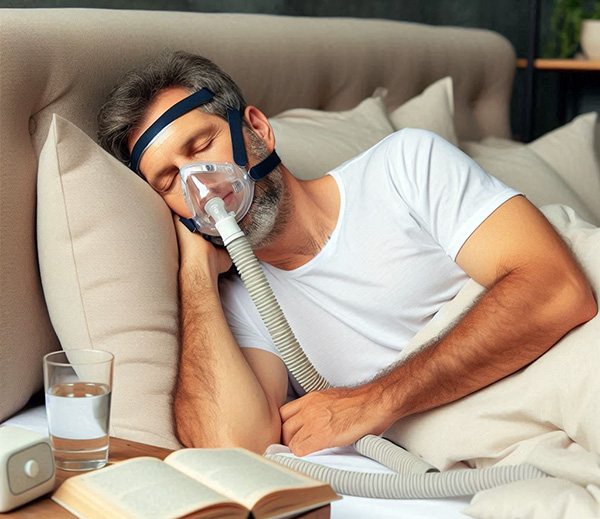
A mask worn overnight delivering a gentle stream of pressurised air that splints the airway open. It works extremely well when tolerated, and it is the pathway the DVLA is most familiar with. Its weakness is adherence: a large proportion of people abandon it, most often in the first weeks and most often because of the mask, the pressure, or a nose that was never unblocked.
-
Mandibular advancement device
A custom dental appliance that holds the lower jaw forward overnight. NICE recommends it for people aged 18 and over with good dental and gum health who cannot tolerate or decline CPAP. It should be made by a dentist with training in sleep medicine — the mail-order versions fit poorly and cause most of the problems these devices are blamed for.
-
Positional therapy
NICE supports a positional modifier for mild or moderate positional disease where other treatments are unsuitable. For people whose apnoea disappears on their side, this can be remarkably effective.
-
Surgical assessment
For moderate or severe disease where CPAP and a dental device have both been tried properly and not tolerated, NICE supports referral for assessment for oropharyngeal surgery. That assessment starts with finding out precisely where the airway is collapsing.
When hospital care is the right answer
Some people need more than a GP can provide, and it is important to recognise when.
I would arrange specialist assessment for anyone with severe disease, anyone who cannot tolerate CPAP despite proper support, anyone whose symptoms persist despite an apparently adequate AHI on treatment, anyone with significant heart or lung disease alongside their sleep apnoea, and anyone whose livelihood depends on a Group 2 driving licence.
The key investigation at that point is a drug-induced sleep endoscopy (DISE). Under light sedation that produces a sleep-like state, a fine flexible camera is passed through the nose to watch the airway collapse in real time. It takes about twenty-five minutes. It is the only technique that shows which structure is obstructing and in what order — the palate, the tonsils, the side walls of the throat, the tongue base, or the epiglottis — and because a hospital treats it as an operative procedure it involves fasting and routine pre-operative checks, with a small risk of a nosebleed.
What follows depends entirely on what the DISE shows. Nasal operations such as septoplasty and turbinate reduction open the nose and make other treatments workable. Palate and uvula procedures stiffen or reduce vibrating tissue. Tonsil and pharyngeal wall procedures address collapse at that level. Tongue base procedures deal with the tongue falling backwards. For selected patients with severe disease who cannot use CPAP, an implanted hypoglossal nerve stimulator gently activates the tongue muscles with each breath. These are single lines here deliberately — which one is relevant only becomes clear once the airway has been examined.
The ISMA clinic exists precisely to remove the delays at this point. I run it jointly with Professor Vik Veer, an ENT consultant sleep surgeon and Founding Chair of the British Association of Sleep Surgeons. You complete a home sleep study and questionnaires, Professor Veer produces a personal video and written report, and then you see me in person to be examined, have your blood results reviewed and agree a plan. If surgical assessment turns out to be needed, the pathway is already in place rather than starting again. The full technical detail is on Professor Veer's snoring and sleep apnoea page.
What to do next
If several of the symptoms above apply to you, the useful next step is a sleep study rather than more speculation. It is a single night in your own bed with a small device, and it gives an answer where questionnaires, wearables and bed-partner accounts cannot.
If you are not sure whether your symptoms warrant it, that is exactly the sort of question a consultation is for. I will take a full history, examine your nose, mouth, throat and jaw, check your blood pressure, arrange blood tests where thyroid function or glucose control may be contributing, and tell you honestly whether testing is worthwhile.
ISMA sleep assessment — £395
Home sleep study, a personalised video and written report from Professor Vik Veer, and a face-to-face consultation with Dr Natasha at 25 Harley Street. No referral needed.
About the sleep clinic 0207 935 1711Frequently asked questions
What are the main symptoms of obstructive sleep apnoea?
The classic three are loud snoring, witnessed pauses in breathing, and daytime sleepiness. Many people, however, have none of these.
The symptoms most often overlooked are waking unrefreshed despite adequate hours in bed, getting up two or three times a night to pass urine, morning headaches, a very dry mouth on waking, night sweats, reflux and throat clearing, poor concentration, low mood or irritability, and reduced libido. Because sleep apnoea develops slowly, people usually attribute all of this to age, stress or overwork.
Can you have sleep apnoea without snoring?
Yes, although it is less common — around 90% of people with obstructive sleep apnoea do snore. Some are silent because the airway closes so completely that no vibration occurs; instead of snoring they simply stop breathing. Others breathe shallowly rather than dramatically, so a bed partner notices nothing alarming.
Sleeping alone is another reason it goes unreported. The absence of snoring does not exclude sleep apnoea.
Can you have sleep apnoea if you are not overweight?
Yes, and this is one of the main reasons the diagnosis is missed. Weight is a risk factor, not a requirement.
Sleep apnoea in people of normal weight is usually driven by the shape of the jaw and airway — a small or set-back lower jaw, a high narrow palate, large tonsils, a deviated septum, or a long soft palate. It is also more common after the menopause, where there is a family history, and in some ethnic groups at lower body weights. If your symptoms fit, ask for a sleep study regardless of your BMI.
How is sleep apnoea diagnosed in the UK?
With a sleep study. NICE recommends home respiratory polygraphy as the first-line test, home oximetry where access to polygraphy is limited, and full polysomnography where the simpler tests are negative but symptoms continue.
Questionnaires such as STOP-BANG and the Epworth Sleepiness Scale indicate whether a study is needed — they cannot make or exclude the diagnosis. Most home studies are posted or couriered to you and worn for one night in your own bed.
What is the AHI and what counts as severe?
The apnoea-hypopnoea index counts how many times per hour your breathing stops or becomes significantly shallower during sleep. Fewer than 5 is normal, 5 to 14 is mild, 15 to 29 is moderate, and 30 or more is severe.
The number is useful but not the whole picture. How far your oxygen levels fall, how fragmented your sleep is, how much of the disturbance happens on your back, and how you actually feel all matter. A modest AHI with heavy oxygen dips can be more significant than a higher AHI without them.
Is sleep apnoea dangerous if left untreated?
Untreated obstructive sleep apnoea is associated with high blood pressure that is often resistant to medication, atrial fibrillation and other arrhythmias, stroke, heart attack, type 2 diabetes and poor blood sugar control, low mood and anxiety, and cognitive difficulties.
It also substantially raises the risk of road traffic accidents — untreated drivers have roughly two to three times the crash risk of the general population. Most of this risk is reversible with effective treatment, which is why diagnosis matters.
Does sleep apnoea always mean CPAP?
No. CPAP is the most effective single treatment, and NICE recommends it for moderate and severe disease and for mild disease affecting quality of life. But it is not the only option and it should not be the first thing that happens.
Nasal blockage and large tonsils should be assessed and dealt with first, because they make CPAP much harder to tolerate. Positional therapy, weight loss, myofunctional therapy and a custom mandibular advancement device all have a role, and surgery is an option for selected patients who cannot use CPAP.
Is sleep apnoea different in women?
The condition is the same but the presentation often is not. Women are more likely to report fatigue, insomnia, low mood, headache and palpitations than loud snoring and witnessed apnoeas, and those symptoms are more readily attributed to something else.
Risk rises substantially after the menopause, when the protective effect of oestrogen and progesterone on airway muscle tone is lost. If you are in your late forties or fifties and sleeping badly, it is reasonable to consider hormonal change and sleep-disordered breathing together rather than assuming one excludes the other.
How long does it take to feel better after treatment?
Some people notice a difference within a few nights, particularly those with severe disease and heavy oxygen dips. For most it is more gradual — two to six weeks of consistent treatment before the daytime difference becomes obvious.
A common experience is that people only realise how tired they had been once it lifts. It is worth persisting through the first fortnight, which is when most people give up.
Do I need a referral to have a sleep study?
Not privately. You can book directly, and the device is posted or couriered to your home so you complete the study in your own bed.
Through the ISMA clinic the assessment includes a home sleep study, a personalised video and written report from Professor Vik Veer, and a face-to-face consultation with me at 25 Harley Street to go through the results, examine you and plan treatment.