How to stop snoring — what actually works, and in what order
Snoring is the sound of the soft tissues of the throat vibrating as air squeezes past a narrowed airway. Most people who snore have several contributing causes at once, which is why single remedies so often disappoint. The approach that works is to deal with them in a sensible order — nose first, then sleep position, alcohol and weight, then throat exercises and, if needed, a dental device.
- Start with the nose. A steroid nasal spray such as fluticasone propionate, two sprays in each nostril twice daily and continued long term, is the single most useful first step — but only if the technique is right.
- Then position. Many people snore only, or mainly, on their back. Side sleeping alone resolves the problem for a substantial minority.
- Alcohol and sedatives in the evening relax the throat muscles and reliably make snoring worse.
- Throat exercises reduce snoring and sleep apnoea severity by around half in published trials, and carry no risk.
- Snoring is not always harmless. If you wake unrefreshed, feel sleepy in the day, or anyone has seen you stop breathing, you need a sleep study rather than a remedy.
Snoring is one of the most common reasons people come to see me about their sleep, and it is almost always the bed partner who books the appointment. It is easy to treat it as a nuisance rather than a medical matter, and for a good number of people that is exactly what it is. But snoring is also the loudest and most obvious sign of a narrowed airway, and a narrowed airway is the same mechanism that produces obstructive sleep apnoea. So the first job is always to work out which of the two you are dealing with — and then, if it is simple snoring, to treat it properly rather than with the usual advice to lose a bit of weight and stop drinking so late.
What follows is the order I actually work through with patients in clinic, and why that order matters.
Why we snore
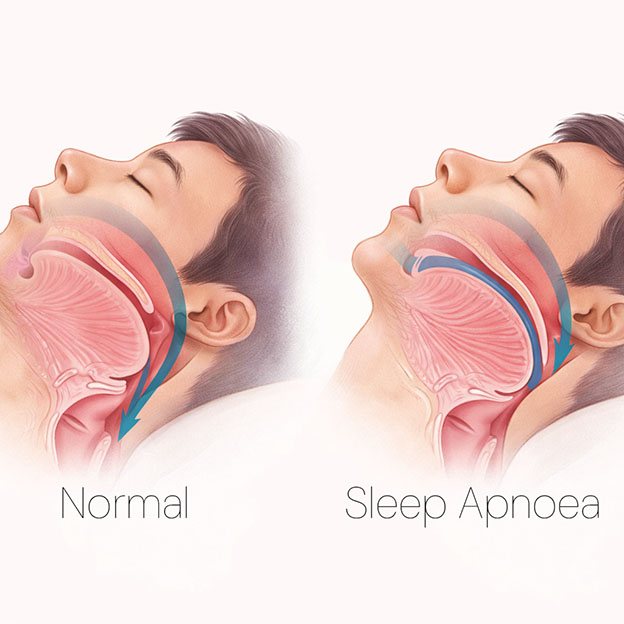
When you fall asleep, the muscles that hold your throat open relax. In most people this is unremarkable. But if the airway is already a little narrow — because of the shape of your jaw, the size of your tonsils, a blocked nose, extra soft tissue around the throat, or simply the loss of muscle tone that comes with age — then the air has to move faster to get through the same space. Fast-moving air through a floppy tube makes the tissues flutter, and that flutter is the noise.
Two things follow from this. The first is that snoring is a mechanical problem, so mechanical solutions tend to work better than pills or sprays sold as anti-snoring remedies. The second is that the narrowing can happen at several places at once — the nose, the soft palate and uvula, the tonsils, the side walls of the throat, the base of the tongue, or the epiglottis at the top of the voice box. This is precisely why one treatment rarely fixes everything, and why people become disheartened after trying three or four gadgets that each helped a little.
First, is it just snoring?
Before treating snoring as a cosmetic problem, it is worth establishing that it is one. Around nine out of ten people with obstructive sleep apnoea snore loudly, so snoring is the commonest presenting feature of a condition that raises blood pressure, disturbs blood sugar control, increases the risk of stroke and atrial fibrillation, and makes people unsafe behind the wheel.
The features that make me want a sleep study rather than a remedy are: snoring loud enough to be heard through a closed door; anyone having witnessed pauses, gasping or choking; waking unrefreshed despite adequate hours in bed; sleepiness during the day; morning headaches; a persistently dry mouth on waking; and getting up two or three times a night to pass urine. None of these is diagnostic on its own, and plenty of people with sleep apnoea report none of them — which is the difficulty.
You cannot reliably tell the difference from symptoms alone. I have seen patients with an apnoea-hypopnoea index above 40 who insisted they slept perfectly well, and patients convinced they had severe sleep apnoea whose studies came back entirely normal. The only way to settle it is a sleep study — and these can now be done in your own bed. I explain the difference in more detail in snoring or sleep apnoea: how to tell the difference.
Step one: open the nose
This is where I start with nearly everybody, and it is the step most often skipped.
A blocked nose does not by itself cause snoring — if it did, everybody with a heavy cold would snore for a week. What it does is force you to breathe through your mouth. Once the mouth opens, the lower jaw drops back, the tongue follows it, and the space behind the tongue narrows. Air then has to travel faster through a smaller gap, and the vibration gets louder. Nasal breathing also produces nitric oxide, which helps the lungs take up oxygen, and it warms and humidifies the air in a way mouth breathing does not.
The nasal spray, and how to use it properly
For most people the right treatment is a steroid nasal spray. I usually recommend fluticasone propionate, which is the active ingredient in Flixonase. It can be prescribed by an NHS GP, or bought over the counter under its generic name at the same dose.
The dose that works is two sprays into each nostril, twice a day, continued long term. That is more than most people are told and for much longer than most people persist. Steroid sprays work by reducing inflammation in the lining of the nose, and particularly in the turbinates — the small ridged structures on the side walls of the nose that warm and humidify the air you breathe. When the turbinates are swollen they block airflow and drive mouth breathing. They take a couple of weeks of consistent use to settle, and they swell straight back up if the spray is stopped.
Technique matters as much as the dose, and a great many people use these sprays in a way that guarantees they will not work. The common mistakes are aiming the nozzle up towards the top of the head, spraying towards the septum in the middle, and sniffing hard afterwards so the medication runs straight down the back of the throat. The better method is to use the opposite hand — left hand for the right nostril — tilt the head slightly forwards, aim outwards towards the ear on that same side, and then breathe in only very gently. If you can taste it, it has gone past the part of the nose you were aiming at.
Do not use decongestant sprays such as Otrivine, Sudafed or Vicks for more than four or five days. They work by cutting blood flow to the lining of the nose, and when the effect wears off the body floods the nose with blood, leaving it more blocked than before. Prolonged use causes rhinitis medicamentosa, a genuine dependence in which people spray many times a day and can end up needing surgery. If you are already in this position, tell your GP — it is fixable, but only once the decongestant is stopped.
If the spray is not enough
Where the nasal blockage is allergic, treating the allergy properly makes a substantial difference. That means identifying the trigger — house dust mite, pets, grass or tree pollen, mould — and treating it consistently rather than seasonally. I have written a full guide to this in hay fever: symptoms, pollen seasons and how to treat it properly, and much of it applies just as well to year-round allergic rhinitis. Antihistamine or combined antihistamine-and-steroid sprays are useful where itching and sneezing are prominent alongside blockage.
Where the spray makes no difference at all, the problem is more likely to be structural — a deviated septum, enlarged bony turbinates, or nasal polyps. A deviated septum in particular rarely improves with any spray. This needs an examination rather than another prescription, and I explain what that involves further down.
Re-learning to breathe through the nose
Once the nose is open, most people improve considerably. But some carry on breathing through the mouth at night purely out of habit, having done so for years. A chin strap, worn overnight, holds the mouth gently closed and prompts the body to return to nasal breathing. It usually takes four to six weeks to retrain, after which the strap can be discarded. A soft cervical collar is an alternative that some find more comfortable — it supports the jaw and neck, stops the mouth falling open, and helps hold the airway in a more open position.
I am deliberately not recommending mouth taping here, which has become popular online. Sealing the lips removes the mouth as a back-up airway, and that matters if you have undiagnosed sleep apnoea. A chin strap achieves the same aim without shutting the airway off.
Step two: sleep position
A large proportion of snoring and mild sleep apnoea is positional — it happens on the back and stops, or nearly stops, on the side. When you lie on your back, gravity pulls the tongue and the soft palate towards the back wall of the throat and the airway narrows. Turn onto your side and the problem can disappear entirely.
In one large real-world audit of over six thousand sleep studies from Professor Vik Veer's NHS practice, 60.3% of patients had their apnoea-hypopnoea index return to the normal range simply by lying on their side, and 85.7% improved by a fifth or more. That is a striking figure for an intervention that costs nothing.
The difficulty is staying there. Tennis balls sewn into pyjamas are the traditional answer and they do work, in the sense that they wake you up when you roll over. The modern versions are more comfortable: a small backpack-style cushion worn at night makes lying on the back uncomfortable enough that you turn without fully waking, and there are purpose-designed pillows that support side sleeping for people who find it painful on the shoulder or hip. Vibrating positional devices worn on the chest or neck are also available and have reasonable evidence behind them.
If your sleep study shows that your breathing is normal on your side and abnormal on your back, positional therapy is not a consolation prize — for many people it is the treatment. It is worth asking specifically whether your study reported positional data, because not every home test does. The ISMA sleep assessment uses devices that record body position through the night, so we can see this directly.
Step three: alcohol, sedatives and smoking
Alcohol in the three or four hours before bed is one of the most reliable ways to make snoring worse. It relaxes the muscles that hold the throat open, deepens the collapse, and suppresses the arousal response that would normally end an obstructive event early. Many people who snore only occasionally snore predictably after a drink, and the pattern is obvious once you look for it.
The same applies to sedating medication — sleeping tablets, some antihistamines, benzodiazepines, opioid painkillers, and muscle relaxants. If you are taking any of these and you snore heavily, it is worth reviewing whether they are still needed, and I am happy to do that as part of a consultation.
Smoking causes chronic inflammation and swelling of the lining of the nose and throat, which narrows the airway in exactly the wrong place. Stopping helps, though it takes some weeks for the swelling to settle.
Step four: weight — honestly
Weight matters, but the way it is usually discussed is unhelpful. Fat is deposited around the tongue and in the side walls of the throat, and that directly narrows the airway. The best-known research found that a 10% fall in body weight was associated with roughly a 26% fall in the apnoea-hypopnoea index, and a 10% gain with a 32% rise. In practice, meaningful weight loss improves snoring and sleep apnoea by something in the order of thirty to forty per cent — which is significant, but rarely curative on its own.
Two things are worth saying plainly. First, plenty of slim people snore heavily and have sleep apnoea; being a healthy weight does not exclude it, and assuming otherwise is one of the commonest reasons the diagnosis is missed in women and in younger adults. Second, the relationship runs in both directions — untreated sleep apnoea disturbs the hormones that regulate appetite and makes weight loss considerably harder, so treating the sleep problem often makes the weight problem more tractable rather than the other way round. If your weight and your metabolic health are both a concern, my article on pre-diabetes and how to reverse it covers the ground in more detail, and I can arrange the relevant blood tests at the same appointment.
Step five: throat and tongue exercises
This is the intervention patients are most sceptical about and most surprised by.
Myofunctional therapy is a structured programme of exercises for the tongue, soft palate, throat and facial muscles. The principle is straightforward: these muscles hold the airway open during sleep, and like any other muscle they respond to training. A systematic review and meta-analysis of the published trials found that myofunctional therapy reduced the apnoea-hypopnoea index by approximately 50% in adults, with improvements in snoring intensity, oxygen levels and daytime sleepiness alongside.
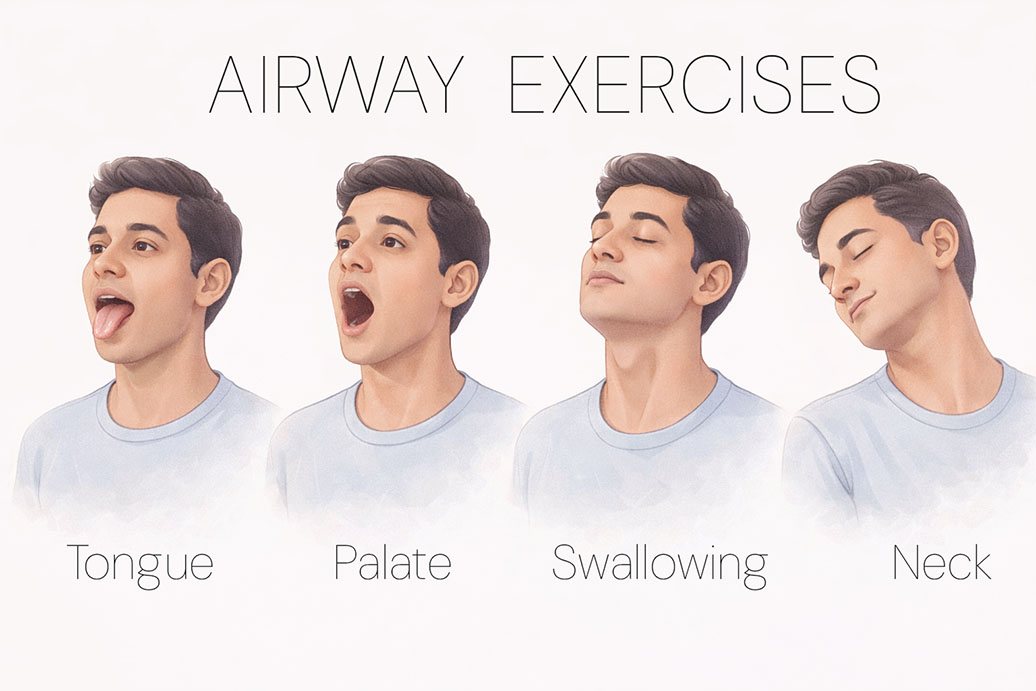
The exercises are simple — sliding the tongue backwards along the roof of the mouth, pressing the tongue against the palate, forceful swallowing, holding vowel sounds, and specific movements of the soft palate. They take a few minutes a day. The catch is consistency: you need to do them daily for six to twelve weeks before judging whether they have helped, and the improvement fades if you stop. Because they carry no risk at all, they are worth trying alongside anything else you are doing rather than instead of it.
Step six: dental devices
A mandibular advancement device is a custom-made dental appliance, rather like a gum shield, that holds the lower jaw slightly forward overnight. Moving the jaw forwards pulls the tongue and the soft tissues attached to it forwards too, which opens the space behind the tongue. For people whose obstruction is at the tongue base, this is the non-CPAP treatment with the strongest evidence behind it, and NICE recommends a customised or semi-customised device for people who cannot tolerate or decline CPAP, provided their dental and gum health is good.
These need to be made properly. The mail-order versions moulded in hot water are cheap and occasionally help, but they fit poorly, and poor fit is what produces the jaw ache and tooth movement that gives these devices a bad name. A device made by a dentist with specific training in sleep medicine, and adjusted over several visits, is a genuinely different proposition. I refer to dental colleagues who work in this field and can arrange that for you.
A tongue-retaining device, which holds the tip of the tongue forward with gentle suction, is sometimes used as a cheaper trial to find out whether tongue position is the problem before committing to a custom appliance. It is not usually a long-term solution, but it can be a useful piece of information.
What does not work, and what to be careful with
Nasal strips and internal nasal dilators can help a little if the narrowest point is the nasal valve just inside the nostril, and they are harmless, so there is no reason not to try one. They will not help if the blockage is further back.
Anti-snoring sprays, oils and throat gels sold to lubricate the palate have very little supporting evidence and, in my experience, very little effect. Anti-snoring pillows that simply change head angle are similarly disappointing unless they are specifically designed to keep you on your side.
Mouth taping, as above, I would avoid until sleep apnoea has been excluded. Long-term decongestant sprays should be avoided altogether. And I would be cautious about any device or programme that is sold on the basis that it will cure sleep apnoea without a diagnosis — the diagnosis is the part that determines everything else.
When you need to be examined
There is a point at which no amount of self-help is the right answer, and someone needs to look inside your nose and throat.
I would want to examine you if the nose is blocked on one side only, or has always been; if you have visible tonsils that touch or nearly touch in the middle; if there is a history of nasal injury; if you have nasal polyps or lose your sense of smell; or if you have been using a steroid spray properly for eight weeks with no improvement. A one-sided blockage that is getting worse, particularly with nosebleeds, numbness of the face or loss of smell, needs to be seen promptly.
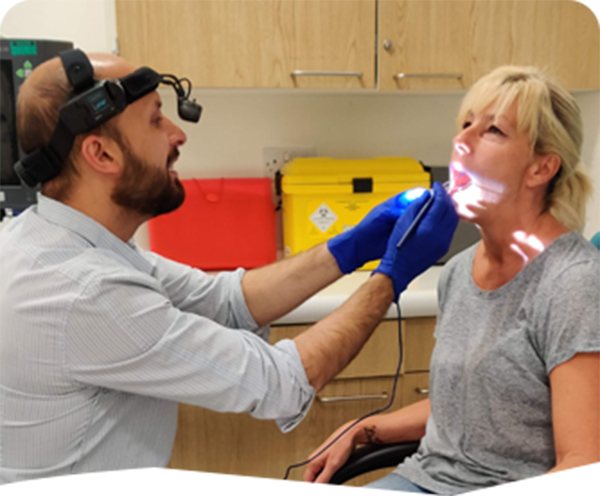
This matters more than it sounds, and not only for snoring. NICE guidance on obstructive sleep apnoea is explicit that people with nasal congestion should be assessed for rhinitis and treated for it, and that tonsillectomy should be considered where there are large obstructive tonsils and a BMI below 35. Doing this before starting CPAP, rather than after, makes an enormous difference to whether people get on with the treatment. I have written about this specifically in before you start CPAP, because it is the thing I most often see done in the wrong order.
When hospital care is the right answer
Most snoring is managed perfectly well without ever seeing a surgeon. But there is a group of patients for whom the conservative measures above genuinely will not be enough, and it is unkind to let them work through the list indefinitely.
If your snoring is severe, you have moderate or severe sleep apnoea, you cannot tolerate CPAP, or several treatments have been tried without success, the next step is to establish precisely where in the airway the problem is. That is done with a drug-induced sleep endoscopy, usually shortened to DISE. A very light sedative is given to produce a sleep-like state, and a fine flexible camera is passed through the nose to watch the airway while you are asleep and snoring. It takes around twenty-five minutes and is the only way to see directly which structures are collapsing and in what order. Because a hospital classifies it as an operative procedure, it involves fasting and routine pre-operative checks, and there is a small risk of a nosebleed.
What DISE gives you is a targeted plan rather than a guess. In broad terms, the surgical options fall into groups: nasal operations such as septoplasty and turbinate reduction to open the nose and improve tolerance of other treatments; palate and uvula procedures to stiffen or reduce tissue that is vibrating; tonsil and pharyngeal wall procedures where the tonsils or side walls are the obstruction; tongue base procedures where the tongue is falling back; and, for selected patients with severe disease who cannot use CPAP, an implanted nerve stimulator that gently activates the tongue muscles with each breath. Each is a line or two here because the detail only becomes relevant once the DISE has shown which one applies to you.
This is where the connection to the ISMA clinic matters. I run that clinic jointly with Professor Vik Veer, an ENT consultant sleep surgeon and Founding Chair of the British Association of Sleep Surgeons. It means that when a patient of mine does need surgical assessment, they are not starting again at the back of a queue — the sleep study, the interpretation and the onward pathway are already joined up. If you want the surgical detail, Professor Veer sets it out in full on his own site, including his guide to DISE and the PTLTbE classification.
How I can help
In a consultation for snoring I take a proper history — including from your partner where possible, because they usually know more than you do — examine your nose, mouth and throat, check your blood pressure, and look at your neck size, jaw shape and tonsils. Where it is relevant I will arrange blood tests, because thyroid problems, anaemia and poorly controlled diabetes all interact with sleep. If a sleep study is warranted, I can arrange one to be posted or couriered to your home, from a straightforward single-night screen through to a three-night high-resolution study, so you sleep in your own bed rather than a hospital ward.
Most of what I have described above — the nasal treatment, the positional advice, the exercises, the medication review, the referral for a dental device — is GP work, and it is the part that helps the largest number of people. Surgery is for the minority in whom it is genuinely needed.
Book a snoring consultation
A proper assessment at Harley Street: history, examination of the nose and throat, and a clear plan — with a home sleep study arranged if one is needed. Always the same doctor, every appointment.
Book an Appointment 0207 935 1711Frequently asked questions
What is the most effective way to stop snoring?
There is no single answer, because snoring has more than one cause and most people have several at once. In practice the most productive order is: get the nose open first, usually with a steroid nasal spray used correctly, twice a day, long term; then address sleep position, evening alcohol and weight; then add throat exercises; and finally consider a dental device made by a dentist trained in sleep medicine.
That order matters. A blocked nose undermines almost every other treatment you try, including CPAP, so fixing it first tends to make everything else work better.
Does a blocked nose cause snoring?
Not on its own — otherwise everybody with a cold would snore permanently. But it makes snoring considerably worse. When you cannot breathe through your nose you breathe through your mouth, the jaw drops back, the airway behind the tongue narrows, and the soft tissues vibrate more.
Treating nasal blockage is the most useful first step for most snorers, and it is also what NICE recommends before starting CPAP for sleep apnoea.
Which nasal spray is best for snoring?
A steroid nasal spray such as fluticasone propionate — the active ingredient in Flixonase — is usually the right choice. The dose that works is two sprays into each nostril twice a day, continued long term rather than for a week or two. It can be prescribed by an NHS GP or bought over the counter under its generic name at the same dose.
Technique matters enormously. Use the opposite hand, tilt your head slightly forward, aim outwards towards the ear on the same side rather than up towards the top of your head, and breathe in only gently afterwards. If you can taste it, it has gone past the part of the nose you were treating.
Should I use a decongestant spray like Otrivine for snoring?
No, other than for a few days at most. Decongestant sprays work by reducing blood flow to the lining of the nose. Used for more than about four or five days they cause rebound congestion — the nose becomes more blocked than it was to begin with, and people end up spraying many times a day.
This is called rhinitis medicamentosa and it can be difficult to reverse. Steroid sprays are slower to work but safe to use long term.
Do throat exercises actually reduce snoring?
Yes, and the evidence is better than most people expect. Myofunctional therapy — a structured set of tongue, palate and throat exercises done daily — has been shown in a systematic review and meta-analysis to reduce the apnoea-hypopnoea index by around 50% in adults, with improvements in snoring intensity, oxygen levels and daytime sleepiness.
They take a few minutes a day, need six to twelve weeks of consistent practice before you judge them, and carry essentially no risk — which makes them worth trying for almost everyone.
Does losing weight stop snoring?
It helps a great deal in many people, but it is not the whole story and plenty of slim people snore. The best-known study found that a 10% reduction in body weight was associated with roughly a 26% fall in the apnoea-hypopnoea index. Weight loss reduces fat around the tongue and the walls of the throat, which is what narrows the airway.
It is worth pursuing, but it should not be the only advice you are given, and it should not delay assessment of your nose and throat. Untreated sleep apnoea also makes weight loss harder, so treating the sleep problem often helps the weight rather than the other way round.
Is mouth taping safe for snoring?
I would not recommend it unless sleep apnoea has been excluded with a proper sleep study and your nose is genuinely clear. Sealing the lips removes the mouth as a back-up airway, which matters if your airway is collapsing at night.
If your aim is to encourage nasal breathing, a chin strap or a soft cervical collar achieves the same thing more safely — they hold the jaw gently closed without sealing the mouth shut. Most people re-learn nasal breathing within four to six weeks and can then stop using them.
Why do I only snore when I sleep on my back?
Because gravity pulls the tongue and soft palate backwards towards the wall of the throat when you lie flat, narrowing the airway at exactly the point where it is most likely to vibrate. On your side the tongue falls forwards instead and the airway stays open.
This pattern is extremely common. In a large audit of over six thousand sleep studies, 60.3% of patients had a completely normal apnoea-hypopnoea index in the side position. If that applies to you, a positional device or a pillow designed to keep you on your side may be all the treatment you need.
When should I see a doctor about snoring?
See a doctor if your snoring can be heard through a closed door, if anyone has seen you stop breathing, gasp or choke, if you wake unrefreshed or feel sleepy during the day, if you wake with headaches or a very dry mouth, or if you get up several times a night to pass urine.
You should also be seen if your nose is blocked on one side only, if your snoring has started or worsened noticeably, if you drive for a living, or if you have high blood pressure, atrial fibrillation or type 2 diabetes that is difficult to control.
Can snoring be cured completely?
Sometimes. Where there is one clear, correctable cause — a badly deviated septum, very large tonsils, or purely back-related snoring — treatment can abolish it entirely.
More often, snoring comes from several sites at once, and the realistic goal is to stack several modest improvements: an open nose, side sleeping, less alcohol, some weight loss, daily exercises. Together these frequently reduce snoring to a level that no longer disturbs anyone, which for most couples is what matters.