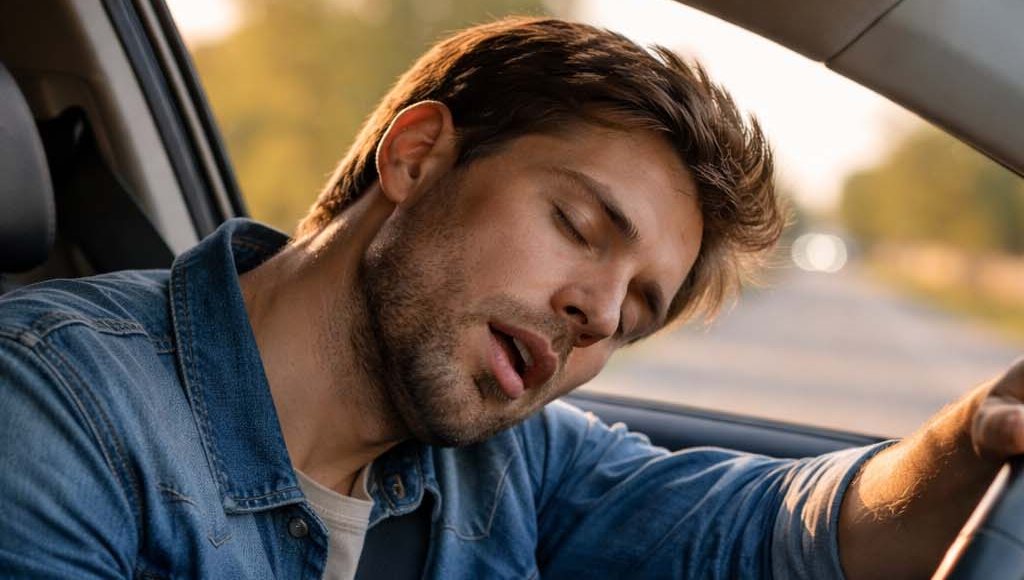
Driving with sleep apnoea: the DVLA rules explained
Obstructive sleep apnoea affects driving because it impairs alertness, reaction time and attention — often without the driver being aware of it. UK law places the duty to notify the DVLA on the driver. The rules are less punitive than most people fear: the DVLA is concerned with whether the condition is being effectively treated, not with whether you have it.
- Group 1 (car, motorcycle): you must not drive and must notify the DVLA if you have moderate or severe obstructive sleep apnoea syndrome with excessive sleepiness. With mild symptoms, do not drive until controlled, and notify if control is not achieved within three months.
- Group 2 (lorry, bus): stricter. Do not drive and notify the DVLA for moderate or severe disease; review is at least annual.
- Severity by AHI: mild is under 15, moderate 15–29, severe 30 or more.
- To resume driving you need controlled symptoms, adherence to treatment, and medical confirmation. For CPAP, adherence is usually four hours a night on 70% of nights; otherwise, a repeat study showing an AHI below 15.
- Not feeling sleepy is not evidence of safety. Objective impairment is common in people who report no sleepiness at all.
This is the aspect of sleep apnoea that worries people most, and it is the one where clear information is hardest to find. Patients arrive either convinced they are about to lose their licence and their job, or entirely unaware that there is any obligation at all. Neither position is right.
What follows is how the rules actually work, why sleep apnoea affects driving in ways you may not be able to feel, and what the route back to normal driving looks like. It is general information rather than legal advice, and the definitive source is always the DVLA's own guidance — but this should tell you what to expect.
Why sleep apnoea affects driving
Every obstructive event fragments sleep. You may not remember waking, but the architecture of the night is broken up hundreds of times, and the restorative deep and REM stages never properly consolidate. The result is a brain running on chronically fragmented sleep.
What that produces is measurable and specific:
- Slower reaction times — a fractional delay in responding to a hazard, which is exactly the margin between stopping safely and not.
- Attention lapses and micro-sleeps — brief moments, sometimes a fraction of a second, when the brain effectively switches off. You will not remember them.
- Reduced peripheral vigilance — things at the edge of vision register more slowly: a cyclist overtaking, a car pulling out, a pedestrian stepping off the kerb.
- Impaired judgement of speed and distance — affecting decisions about overtaking, braking and gap acceptance.
Driving simulator studies have found that people with untreated obstructive sleep apnoea make errors at rates comparable to drivers who are over the alcohol limit. And the parallel with alcohol goes further: someone who has had too much to drink genuinely believes they are fine. Their self-assessment is the first thing that goes.
"I don't feel tired" is not evidence that you are safe. In one study, 17.7% of people with sleep apnoea had objectively impaired alertness on formal testing while reporting no subjective sleepiness whatsoever. In another, a quarter of people who had experienced sleepiness at the wheel had no excessive daytime sleepiness by standard measures. The impairment is real; the perception of it is not reliable.
The size of the risk
Multiple large studies converge on a similar figure. People with untreated obstructive sleep apnoea have roughly two to three times the motor vehicle crash risk of the general population. Professional drivers with the condition have around 2.3 times the risk of accidents and near misses. A Swedish registry study of CPAP users found a crash risk ratio of 2.45 compared with population controls before treatment.
Severity matters, but not in the straightforward way people assume. A higher apnoea-hypopnoea index and greater sleepiness are both associated with more crashes — yet AHI alone is a poor predictor of individual crash risk. Someone with an AHI that looks mild on paper can be genuinely unsafe. This is one of several reasons not to treat the number as the whole picture.
The other side of these figures is genuinely encouraging. CPAP used consistently reduces crash risk by around 70%, bringing it close to the general population. Registry data has shown real-world crash rates falling from 7.6 to 2.5 per 1,000 drivers per year among those using CPAP for at least four hours a night. Treatment works — but only if it is used.
The DVLA rules
UK licences are divided into two groups. Group 1 covers cars and motorcycles. Group 2 covers lorries, buses and coaches. The standards for Group 2 are considerably stricter, because of the size of the vehicles, the hours driven and the consequences of a collision.
Severity is defined on the sleep study, or an equivalent measure:
| Severity | Apnoea-hypopnoea index (AHI) |
|---|---|
| Mild | Below 15 |
| Moderate | 15 to 29 |
| Severe | 30 or more |
The DVLA standards concern obstructive sleep apnoea syndrome — the condition together with excessive sleepiness — rather than an abnormal sleep study on its own. Excessive sleepiness in this context means sleepiness that has affected, or is likely to affect, safe driving.
| Situation | Group 1 — car, motorcycle | Group 2 — lorry, bus |
|---|---|---|
| Suspected sleep apnoea, not yet diagnosed | Do not drive if you are experiencing excessive sleepiness. Get assessed. | Do not drive if you are experiencing excessive sleepiness. Get assessed urgently. |
| Mild OSAS, or sleepiness caused by medication | Must not drive until symptoms are satisfactorily controlled. Notify the DVLA if control is not achieved within three months. | Must not drive until symptoms are satisfactorily controlled. Notify the DVLA if control is not achieved within three months. |
| Moderate or severe OSAS with excessive sleepiness | Must not drive and must notify the DVLA. Driving may resume once the condition is controlled, sleepiness has improved, and adherence to treatment is medically confirmed. | Must not drive and must notify the DVLA. Same requirements, applied more strictly. |
| Once treated and licensed again | Review at least every three years. | Review at least annually. |
Two practical points. First, the duty to notify sits with you, not with your doctor — and it is a duty, not a courtesy. Second, notifying does not automatically mean losing your licence. In most cases the DVLA wants evidence that the condition is being managed, and providing it promptly is by far the quickest way through.
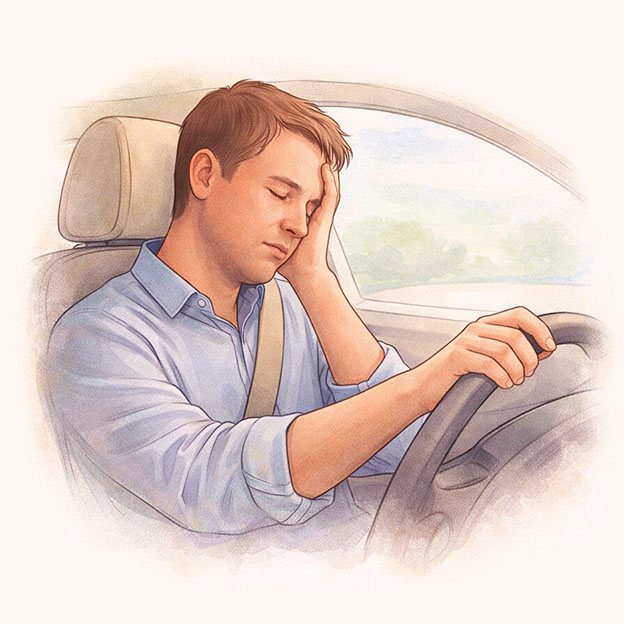
Getting your licence back
Three things need to be established.
-
The condition is controlled
Your treatment is working — demonstrated either by adherence data from a CPAP machine or by a repeat sleep study.
-
The sleepiness has resolved
You are no longer experiencing sleepiness that could affect safe driving.
-
A doctor confirms it
The DVLA will require medical confirmation, usually from the clinician managing your sleep apnoea. This is straightforward when the treatment records exist.
The CPAP route
The usual standard is at least four hours a night on 70% of nights, sustained over about three months. CPAP machines record this automatically, so the evidence is generated for you — you simply need to make sure the data is being downloaded and that whoever provided the machine can produce a report.
It is worth being clear that this is a licensing threshold, not a health target. Sleep apnoea returns the instant the mask comes off, so four hours out of eight leaves half the night untreated. For how you actually feel, the aim should be all night, every night.
The non-CPAP route
If you are not using CPAP, the usual alternative is a repeat sleep study showing an apnoea-hypopnoea index below 15 on treatment. That applies whether the treatment is a custom mandibular advancement device, a positional device that keeps you off your back, weight loss, or surgery. The requirement is evidence of effect, not a particular brand of therapy.
If your licence is at stake, the speed of the process matters as much as the outcome. Waiting several months for an initial sleep study, and then several more for treatment, is what causes people to lose income. Private home sleep studies can usually be arranged within days and the results turned round quickly — which is the main reason drivers come to see me rather than waiting.
What happens if you do not declare
Failing to notify the DVLA of a condition that affects your driving is a criminal offence, and it carries a fine of up to £1,000. If you are involved in a collision, you may face prosecution.
The insurance consequence is arguably more serious. You must tell your motor insurer about any medical condition that could affect your driving. If you have not, your policy may be invalid, which can leave you personally liable for the full cost of damage and injury — potentially a very large sum indeed.
People are sometimes tempted to under-report symptoms when a licence and a livelihood are at stake. It is an understandable impulse and a poor calculation, because the risk being carried is not just legal.
If you drive for a living
Group 2 drivers — HGV, bus and coach — are held to stricter standards throughout, and are reviewed at least annually once licensed. Taxi and private hire drivers are licensed by their local authority rather than the DVLA, but most authorities apply Group 2 medical standards.
NICE specifically identifies vocational drivers and people in vigilance-critical occupations as a priority group for rapid assessment of suspected sleep apnoea, alongside people with unstable cardiovascular disease, women who are pregnant, and people being assessed before major surgery. If that is you, do not join the back of a queue.
The practical advice I give professional drivers is straightforward: get tested quickly, start treatment properly, and document everything. The drivers who lose the most time are usually those who delayed testing, or who were issued with CPAP and struggled with it for months because nobody addressed a blocked nose. That is worth reading about in before you start CPAP, because it is the difference between three months off the road and a year.
Shift work and long journeys
Both compound the risk considerably. Shift work disrupts circadian rhythm on top of already-fragmented sleep, and long-distance driving exposes you to the times of day when alertness is naturally lowest — the early hours of the morning and the mid-afternoon dip.
If either applies and you have or suspect sleep apnoea, treatment is not optional. In the meantime, the standard advice about sleepiness at the wheel is worth repeating because it is genuinely effective in the short term: stop somewhere safe, drink two cups of strong coffee, and take a nap of fifteen to twenty minutes. Opening the window and turning up the radio are not countermeasures.
What to do if you are worried
If you snore, feel unrefreshed, or have ever felt sleepy at the wheel, the useful step is to establish whether you have sleep apnoea rather than to speculate about it. A home sleep study gives a definite answer from a single night in your own bed.
In a consultation I will take a full history, use the standard screening tools — STOP-BANG and the Epworth Sleepiness Scale — examine your nose, throat and jaw, check your blood pressure, and arrange a sleep study if it is warranted. Where treatment is needed I will help you get it started and, importantly, get it working, and provide the documentation you will need for the DVLA.
Where the picture is complex, or where surgical assessment may be needed because CPAP cannot be tolerated, the ISMA clinic gives a direct route. I run it jointly with Professor Vik Veer, an ENT consultant sleep surgeon and Founding Chair of the British Association of Sleep Surgeons, so the sleep study, its interpretation and any onward specialist assessment are already joined up.
The definitive source is the DVLA's Assessing fitness to drive guidance, in the section on miscellaneous conditions, and you can notify the DVLA online at gov.uk/sleep-apnoea-and-driving. If you are unsure whether your situation requires notification, ask your doctor — and if it is genuinely borderline, notifying is the safer course.
Rapid assessment for drivers
Home sleep study arranged quickly, full assessment at Harley Street, and the documentation you need for the DVLA. Appointments Monday to Friday.
Book an Appointment 0207 935 1711Frequently asked questions
Do I have to tell the DVLA I have sleep apnoea?
It depends on severity and symptoms. For a Group 1 licence (cars and motorcycles) you must not drive and must notify the DVLA if you have moderate or severe obstructive sleep apnoea syndrome with excessive sleepiness. With mild symptoms you must not drive until they are controlled, and you must notify the DVLA if control cannot be achieved within three months.
For a Group 2 licence (lorries and buses) the rules are stricter and any diagnosis should be discussed with the DVLA. If you are unsure, the safe course is to notify — the penalty for not doing so is significant and your insurance may be invalidated.
How does the DVLA define mild, moderate and severe sleep apnoea?
By the apnoea-hypopnoea index on a sleep study, or an equivalent measure: mild is an AHI below 15, moderate is 15 to 29, and severe is 30 or more.
The DVLA's decisions turn on excessive sleepiness as much as on the number, because the standards concern obstructive sleep apnoea syndrome — the condition together with symptoms — rather than an abnormal sleep study alone.
Will I lose my driving licence if I have sleep apnoea?
Usually not permanently. The DVLA's concern is whether the condition is being effectively managed, not whether you have it.
If you are diagnosed and treated promptly, and can show that your symptoms are controlled and your treatment is being used properly, most people keep or quickly regain their licence. Group 1 licences are then typically reviewed at least every three years, and Group 2 licences at least annually.
What do I need to get my licence back after sleep apnoea?
Broadly three things: satisfactory control of the condition, resolution of excessive sleepiness, and evidence that you are adhering to treatment — confirmed medically.
For CPAP users, adherence is usually taken as at least four hours a night on 70% of nights, which the machine records automatically. Where CPAP is not used, a repeat sleep study showing an apnoea-hypopnoea index below 15 is the usual alternative, and that applies equally to mandibular advancement devices, positional therapy and surgery.
What happens if I do not tell the DVLA?
Failing to notify the DVLA of a condition that affects your driving is a criminal offence and can carry a fine of up to £1,000. If you are involved in a collision you may face prosecution.
Your motor insurance may also be invalid, which can leave you personally liable for damages and injury costs. You must tell your insurer about any medical condition that could affect your driving.
I do not feel sleepy — am I safe to drive?
Not necessarily, and this is the most dangerous misconception about sleep apnoea and driving.
Research has found that a significant proportion of people with sleep apnoea show objective impairment of alertness on formal testing while reporting no subjective sleepiness at all, and that a quarter of people who had experienced sleepiness at the wheel scored normally on standard questionnaires. Slower reaction times, attention lapses and reduced peripheral vigilance are not reliably perceptible from the inside.
Can I drive while I am waiting for a sleep study?
This depends on whether you are experiencing excessive sleepiness. If you have felt sleepy at the wheel, had a near miss, or been advised that your driving may be impaired, you should not drive until the situation is assessed and treated.
If you drive professionally or hold a Group 2 licence, get assessed urgently rather than waiting. Private home sleep studies can usually be arranged within days, which is often the quickest way to resolve the uncertainty.
Do the rules differ for HGV, bus and taxi drivers?
Yes. Group 2 licence holders — lorries, buses and coaches — are held to stricter standards, must not drive and must notify the DVLA where there is moderate or severe obstructive sleep apnoea syndrome, and are reviewed at least annually.
Taxi and private hire licensing is handled by the local licensing authority rather than the DVLA, but most authorities apply Group 2 medical standards. If your livelihood depends on driving, prompt diagnosis and documented treatment is the fastest route back to work.
Does treating sleep apnoea reduce crash risk?
Substantially. Untreated obstructive sleep apnoea is associated with roughly two to three times the crash risk of the general population. CPAP used properly reduces that by around 70%, bringing it close to the population baseline.
Registry data has shown real-world crash rates falling from 7.6 to 2.5 per 1,000 drivers per year when CPAP is used for at least four hours a night. The benefit depends entirely on consistent use — a machine in the cupboard protects nobody.
Do I need to tell my employer?
If you drive as part of your job, or your role is safety-critical, then in practice yes — and many employers have occupational health processes designed for exactly this. Employers have their own duties around road risk, and being open usually results in support rather than sanction.
If you do not drive for work and your role is not safety-critical, there is generally no obligation. Your obligation to the DVLA and your insurer is separate and applies regardless.
Key sources
- DVLA. Assessing fitness to drive: a guide for medical professionals — miscellaneous conditions (obstructive sleep apnoea syndrome and excessive sleepiness). gov.uk
- National Institute for Health and Care Excellence. Obstructive sleep apnoea/hypopnoea syndrome and obesity hypoventilation syndrome in over 16s (NG202), August 2021. nice.org.uk/guidance/ng202
This article is general medical information and is not legal advice. Licensing decisions are made by the DVLA on the basis of your individual circumstances.