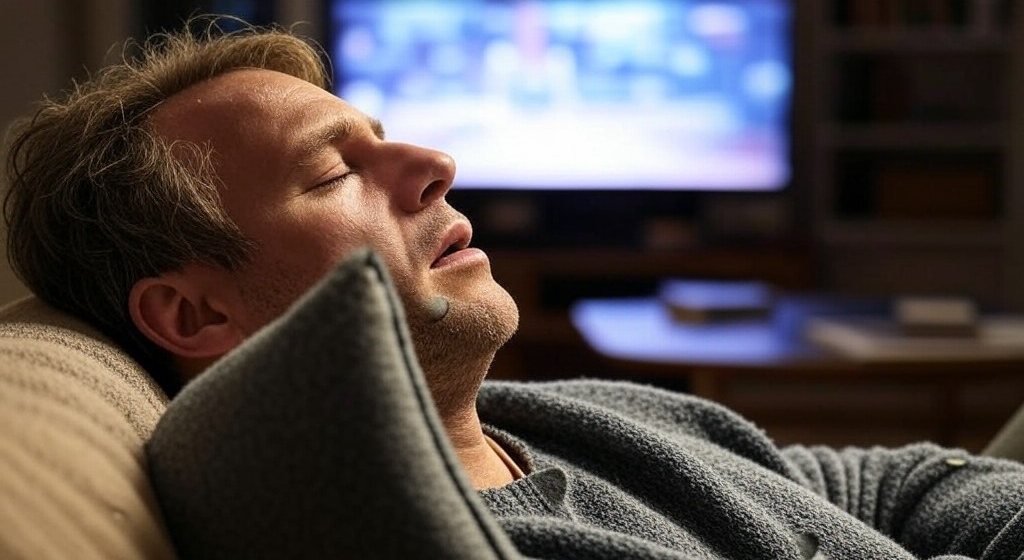
Snoring or sleep apnoea? How to tell the difference
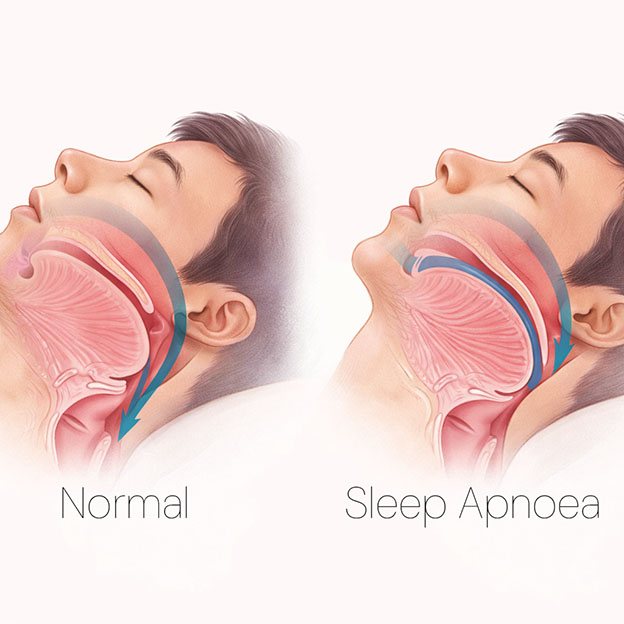
Snoring means the airway is narrowed but still open — the noise is soft tissue vibrating as air squeezes past. Obstructive sleep apnoea means the airway closes altogether, breathing stops, oxygen falls, and the brain has to rouse you to reopen it. The two look and sound similar from the outside, which is why symptoms alone cannot settle the question.
- They are the same spectrum, not two separate conditions. Around 90% of people with sleep apnoea snore loudly.
- The most useful clue is not how loud the snoring is but whether it is interrupted — silence, then a snort or gasp.
- Symptoms are unreliable in both directions. Plenty of people with severe sleep apnoea feel fine; plenty of anxious snorers turn out to have nothing.
- A wearable cannot answer this. Consumer trackers do not measure airflow or breathing effort.
- A home sleep study can. One night, in your own bed, and you have a definite answer.
This is the question that brings most people to my clinic when sleep is the issue. Usually a partner has said something, or the person has read about sleep apnoea and recognised themselves in it, and they want to know whether the snoring is simply an irritating noise or a sign of something that needs treating.
It is a good question, and the honest answer is that you cannot reliably work it out from home. But you can work out whether you need to find out — and that is genuinely worth doing, because the two conditions have very different implications.
What is physically happening in each
Snoring happens when the airway is narrowed. Air has to travel faster to get through the same space, and fast air moving past loose tissue makes it flutter. The soft palate, the uvula, the tonsils and the base of the tongue are the usual culprits. The airway is narrow, but air is still getting through.
Obstructive sleep apnoea is what happens when the same airway narrows past the point of collapse. Instead of vibrating, the tissues meet and airflow stops entirely — an apnoea — or falls dramatically — a hypopnoea. You go on trying to breathe; the chest and abdomen keep working, often harder and harder, but nothing moves. Oxygen levels fall by three or four per cent, sometimes far more, and the brain responds by lifting you briefly out of deep sleep so that muscle tone returns and the airway reopens. You take a deep breath, settle back down, and because nothing has changed, it happens again.
In severe cases this can occur every thirty seconds throughout the night. Almost nobody remembers a moment of it.
One spectrum, not two conditions
It helps to think of sleep-disordered breathing as a continuum rather than a set of separate diseases.
| Where on the spectrum | What happens | Typical picture |
|---|---|---|
| Primary (simple) snoring | Airway narrowed; tissues vibrate; no significant drop in oxygen and no sleep fragmentation. | Noise disturbs the partner more than the snorer. Daytime function is normal. |
| Upper airway resistance syndrome (UARS) | Increased effort to breathe against resistance repeatedly disturbs sleep, without enough oxygen drop to score as apnoeas. | Often slim, often women. Unrefreshing sleep, fatigue, headaches, light-headedness, anxiety. Standard studies can report "normal". |
| Obstructive sleep apnoea | Airway closes completely or near-completely; oxygen falls; repeated arousals fragment sleep. | Loud interrupted snoring, witnessed pauses, unrefreshing sleep, nocturia, morning headache, daytime sleepiness. |
The same person can move along this spectrum over time. Loss of muscle tone with age, weight gain, alcohol, sedating medication, the menopause and worsening nasal blockage all narrow the margin. This is why a normal sleep study five years ago is not a guarantee about today.
Upper airway resistance syndrome is the one most often missed. If you have been told your sleep study was normal but you remain exhausted, and particularly if you are slim and female, it is worth asking whether the study was scored for breathing effort rather than only for apnoeas and oxygen dips. More detailed analysis exists and can be arranged.
The clues that point towards apnoea
None of these is diagnostic on its own. Together they shift the probability enough to justify testing.
What the snoring sounds like
Volume matters less than pattern. Continuous, even snoring is more likely to be simple snoring. Snoring that builds, stops abruptly, is followed by ten or twenty seconds of silence, and then resumes with a snort or a gasp is the sound of an apnoea and its termination. If your partner can describe that rhythm, take it seriously.
Recording yourself is genuinely useful here. A phone left running overnight, or one of the snore-recording apps, will not diagnose anything — but hearing the interruptions for yourself is often what prompts people to act.
What you notice in the day
Waking unrefreshed after seven or eight hours; needing caffeine to function rather than to enjoy; nodding off in front of the television, in meetings, or as a passenger; word-finding difficulty and forgetfulness; irritability and short temper that are out of character. In simple snoring, daytime function is generally normal.
What you notice at night and first thing
Getting up two or three times to pass urine. A very dry mouth or sore throat on waking. Headache on waking that eases within the first hour. Night sweats. Reflux, throat clearing or hoarseness. These are the ones people rarely connect to their breathing, and they are often the most telling.
What else is going on medically
Blood pressure that needs three or more medicines. Atrial fibrillation. Type 2 diabetes with stubborn control. Unexplained fatigue that has been investigated without an answer. Low mood that has not responded fully to treatment. Any of these alongside snoring raises the priority considerably.
Some situations warrant prompt assessment regardless of how you feel: if you drive for a living or hold a Group 2 licence; if you have ever felt sleepy at the wheel; if you have unstable heart disease; if you are pregnant; or if you are about to have major surgery. These are the groups NICE identifies as priorities for rapid assessment. The driving side is covered in driving with sleep apnoea and the DVLA rules.
Why symptoms alone cannot settle it
This is the part I find myself explaining most often, and it cuts both ways.
People with significant sleep apnoea frequently feel fine. Because the condition develops over years, the tiredness becomes the baseline and gets attributed to work, age or family life. A person can have thirty events an hour and score entirely normally on the Epworth Sleepiness Scale. In one study of drivers with sleep apnoea, nearly one in five had objective impairment on formal testing while reporting no subjective sleepiness at all.
Equally, plenty of people who are convinced they have sleep apnoea do not. Poor sleep has many causes — insomnia, shift work, anxiety, alcohol, restless legs, perimenopause, thyroid disease, iron deficiency, and simply not spending enough hours in bed. Testing is as useful for ruling out as for ruling in, and knowing that your breathing is fine redirects attention to whatever is actually responsible. My article on whether sleep hygiene actually works covers some of that ground.
What a smartwatch or ring can and cannot tell you
Consumer wearables infer sleep from movement and from an optical heart rate sensor. They do not measure airflow. They do not measure the effort you are making to breathe. Most do not measure blood oxygen across the night in a way that has been validated for diagnosis. Someone with moderate or severe sleep apnoea can produce an entirely unremarkable sleep score, because the device is blind to the mechanism causing the problem.
They are not useless — trends in resting heart rate and total sleep duration over weeks are reasonably reliable, and they are good at prompting people to take sleep seriously. But a reassuring score is not reassurance. I have written about this in detail in can your sleep tracker detect sleep apnoea?.
Screening questionnaires
Two are worth knowing about.
STOP-BANG asks eight yes-or-no questions: loud Snoring, daytime Tiredness, Observed apnoeas, high blood Pressure, BMI over 35, Age over 50, Neck circumference over 40cm, and male Gender. A score of 0–2 suggests low risk, 3–4 intermediate, and 5–8 high risk. It is deliberately over-inclusive: it is designed to catch nearly everyone who has the condition, accepting that it will also flag people who do not. An intermediate or high score is a reason to have a sleep study, not a diagnosis.
The Epworth Sleepiness Scale asks how likely you are to doze in eight everyday situations, scoring each 0–3. Above 10 is generally taken as excessive sleepiness. As above, a normal score does not exclude anything — it measures how sleepy you feel, not how alert you actually are.
The test that does settle it
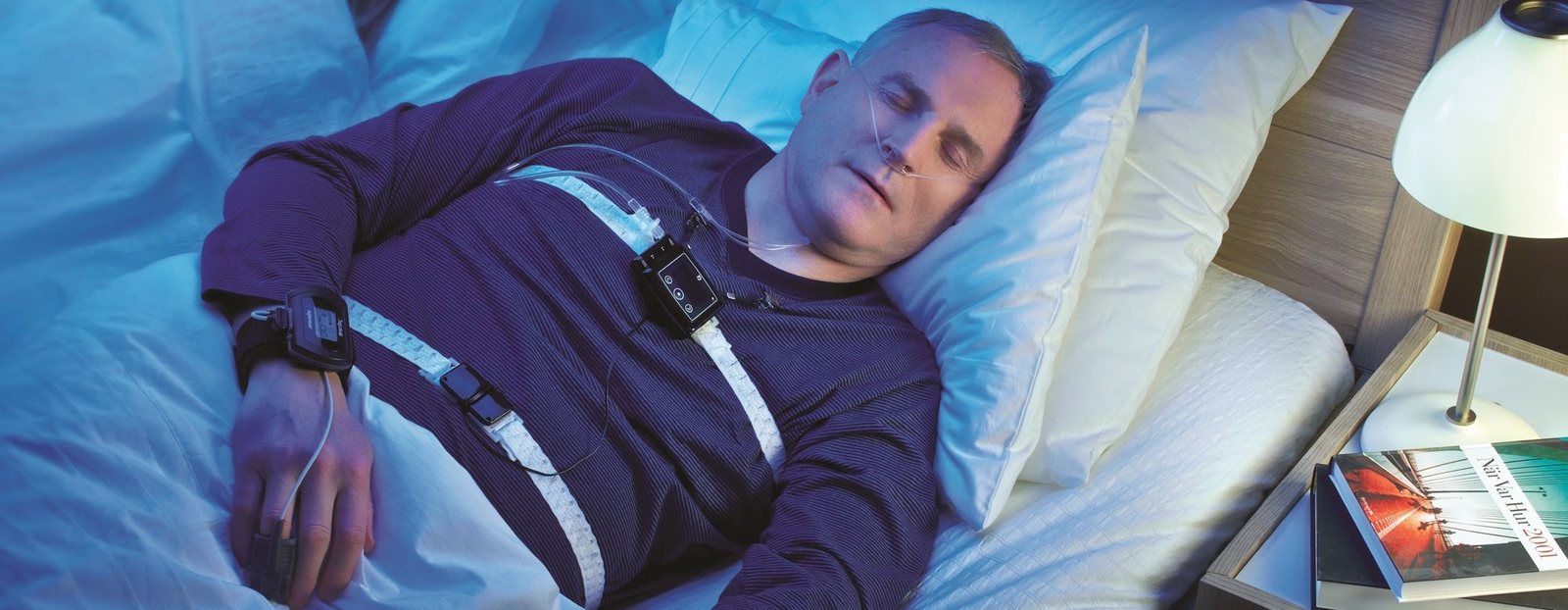
A sleep study measures what a questionnaire cannot: airflow, breathing effort, oxygen saturation, pulse, snoring intensity, body position, and — on the more detailed devices — sleep stage. It produces an apnoea-hypopnoea index: the number of times per hour your breathing stopped or became significantly shallower. Under 5 is normal, 5 to 14 mild, 15 to 29 moderate, 30 or more severe.
NICE recommends home respiratory polygraphy as the first-line test, with full polysomnography reserved for cases where a simpler negative test does not fit the symptoms. In practice a home study is also the better test for most people, because a first night in a hospital sleep laboratory in an unfamiliar bed is rarely representative.
I can arrange the whole range — a straightforward posted single-night screen, multi-night recordings that capture how much your breathing varies from night to night, advanced studies that add body position and REM data, full home polysomnography set up at your home by a sleep technologist, and detailed manual analysis for suspected upper airway resistance syndrome. Which one is right depends on the question we are trying to answer.
If it turns out to be snoring
That is good news, and it does not mean nothing can be done. Snoring responds well to a systematic approach: opening the nose properly with a steroid spray used at the right dose and with the right technique, sleeping on your side, reducing evening alcohol, losing weight where relevant, daily throat and tongue exercises, and — where the tongue is the problem — a dental device made by a dentist trained in sleep medicine. The full sequence is in how to stop snoring.
If it turns out to be sleep apnoea
Then the priority is treating it, and doing so in a sensible order. Nasal blockage and large tonsils should be assessed and dealt with first, because they undermine every other treatment — CPAP in particular. NICE says this explicitly, and it is the step most often skipped; I have given it its own article for that reason. After that, treatment depends on severity, on where in the airway the problem is, and on what you can actually live with: CPAP, a custom mandibular advancement device, positional therapy, weight loss, myofunctional therapy, or a combination.
A minority of people need surgical assessment — usually those with moderate or severe disease who cannot tolerate CPAP or a dental device. That begins with a drug-induced sleep endoscopy, a short procedure under light sedation in which a fine camera is used to watch the airway collapse in real time, showing exactly which structure is responsible. It is the only way to target surgery properly rather than guess.
This is why the ISMA clinic exists. I run it with Professor Vik Veer, an ENT consultant sleep surgeon and Founding Chair of the British Association of Sleep Surgeons. You do the sleep study at home, Professor Veer produces a personal video and written report explaining your results, and then you see me face to face to be examined and plan what happens next. If specialist or surgical input is needed, the pathway is already connected rather than starting from scratch.
Find out which one it is
The ISMA sleep assessment is £395 and includes a home sleep study, a personalised video and written report from Professor Vik Veer, and a face-to-face consultation with Dr Natasha at 25 Harley Street. No referral needed.
About the sleep clinic 0207 935 1711Frequently asked questions
What is the difference between snoring and sleep apnoea?
Snoring is the sound of soft tissue in the throat vibrating as air squeezes through a narrowed airway — the airway is narrow but still open. In obstructive sleep apnoea the airway closes completely or almost completely, so airflow stops altogether.
Oxygen levels then fall, the brain briefly rouses you to reopen the airway, and the cycle repeats — often dozens or hundreds of times a night. Snoring is a noise; sleep apnoea is an interruption to breathing with measurable effects on oxygen levels, sleep quality and long-term health.
How do I know if my snoring is sleep apnoea?
The most useful pointers are snoring that stops abruptly and then resumes with a snort or gasp, anyone having witnessed you stop breathing, waking unrefreshed after adequate hours in bed, daytime sleepiness, morning headaches, a very dry mouth on waking, and getting up two or three times a night to pass urine.
None of these is reliable enough to make or exclude the diagnosis. The only way to be sure is a sleep study, which can now be done overnight in your own bed.
Is simple snoring harmful?
Primary snoring without apnoeas is not thought to carry the cardiovascular and metabolic risks associated with obstructive sleep apnoea. It is not entirely without consequence, though — very loud snoring can fragment your own sleep and it very reliably fragments your partner's, and there is some evidence linking heavy snoring to changes in the carotid arteries independent of apnoea.
It is also worth remembering that snoring can progress to sleep apnoea over the years as muscle tone falls and weight changes.
Can snoring turn into sleep apnoea?
Yes. Snoring and obstructive sleep apnoea sit on the same spectrum of sleep-disordered breathing, and the same airway can move along it over time.
Loss of muscle tone with age, weight gain, alcohol, sedating medication, the menopause, and worsening nasal blockage all narrow the margin. This is why persistent loud snoring is worth reassessing even if a study some years ago was normal.
What is UARS and how is it different?
Upper airway resistance syndrome sits between snoring and sleep apnoea. The airway does not close completely and oxygen levels may not fall enough to register as apnoeas or hypopnoeas, but the effort of breathing against resistance repeatedly disturbs sleep.
People with UARS are often slim, frequently women, and typically report unrefreshing sleep, fatigue, headaches, light-headedness and anxiety rather than classic loud snoring. Because standard scoring can miss it, a study reported as normal does not always mean nothing is wrong — more detailed manual analysis is available.
Can my partner tell whether I have sleep apnoea?
Only partly. A partner who reports witnessed pauses, gasping or choking is giving you important information and it should be acted on.
But partners are poor at excluding it. Many obstructive events are undramatic — breathing becomes progressively shallower rather than stopping visibly. Interruptions to the rhythm of snoring are a more useful clue than obvious breath-holding, which tends to be a late and severe sign.
Is a smartwatch or sleep app enough to tell the difference?
No. Consumer wearables estimate sleep from movement and optical heart rate. They do not measure airflow or breathing effort, and most do not measure blood oxygen in a way validated for diagnosis. Someone with thirty or forty breathing pauses an hour can produce a perfectly normal-looking sleep score.
Snoring-recording apps are more useful in one narrow respect: they can demonstrate that snoring is happening and roughly how loud it is. They still cannot distinguish snoring from apnoea.
What is the STOP-BANG questionnaire?
STOP-BANG is a validated eight-item screening questionnaire covering snoring, tiredness, observed apnoeas, blood pressure, BMI over 35, age over 50, neck circumference and male sex. Scoring 0–2 suggests low risk, 3–4 intermediate, and 5–8 high risk.
It is deliberately designed to catch as many affected people as possible, so it over-identifies. An intermediate or high score means you should have a sleep study — it does not mean you have sleep apnoea.
Can children have sleep apnoea rather than just snoring?
Yes, and in children the commonest cause is enlarged tonsils and adenoids. The presentation differs from adults: children are more likely to be restless, sweaty and mouth-breathing at night, and to be irritable, hyperactive or struggling at school during the day rather than obviously sleepy.
Persistent snoring in a child, particularly with witnessed pauses or unusual sleeping positions with the neck extended, should be assessed rather than watched. Home sleep studies are available for children as well as adults.