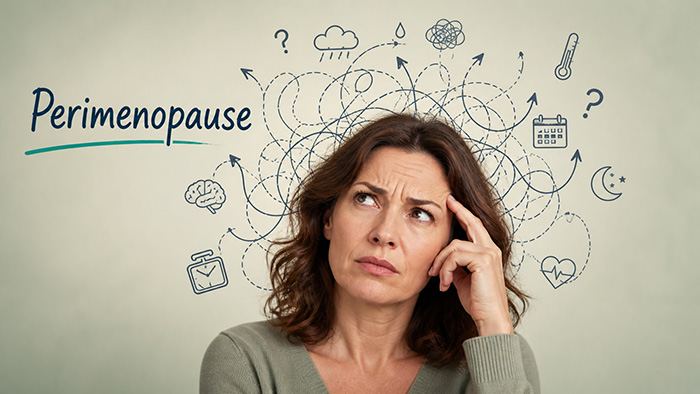
What is perimenopause — and how do you know if you're in it?
Most women have heard of the menopause. Far fewer are familiar with the years leading up to it — a transition that can be harder to navigate, more confusing, and more commonly overlooked than the menopause itself.
In my clinic at Harley Street, I see women in their 40s — and sometimes late 30s — who have spent months, occasionally years, seeking explanations for symptoms that have been attributed to stress, anxiety, depression, or simply the demands of a busy life. In a significant number of these cases, what we are actually dealing with is perimenopause.
Perimenopause is not a vague or imprecise concept. It is a defined hormonal transition — the years during which the ovaries begin to wind down their function and oestrogen levels start to fluctuate. It is, in many ways, the story of oestrogen becoming unreliable rather than simply declining. Because oestrogen receptors are found throughout the entire body — in the brain, joints, skin, heart, bladder, and gut — that unreliability can produce a wide range of symptoms, many of which have nothing obviously to do with reproduction.
This article is my attempt to explain what perimenopause actually is, what it can feel like, why it is so frequently overlooked, and what can be done about it.
What is perimenopause, precisely?
Perimenopause is the transitional phase that precedes the menopause. The menopause itself is a clearly defined clinical milestone: 12 consecutive months without a menstrual period. Everything before it — the months and years of hormonal fluctuation, changing cycles, and emerging symptoms — is the perimenopause.
The European Society of Endocrinology describes it as lasting typically two to four years, ending one year after the final menstrual period. The individual experience varies considerably, however. Vasomotor symptoms — hot flushes and night sweats — can begin years before periods become irregular, and research shows that for symptomatic women these can persist for a median of around four years. For those whose symptoms begin earliest in the transition, some studies suggest vasomotor symptoms can continue for considerably longer.
Perimenopause does not begin when your periods become irregular. It begins when your hormones start fluctuating — which can be happening for months or years before any change in your cycle is apparent. Symptoms can predate cycle changes entirely.
This matters because many women — and indeed many clinicians — associate perimenopause exclusively with irregular periods or hot flushes. If neither has happened yet, the possibility may not be considered. But the hormonal shift, and the symptoms it causes, can be well underway long before the period changes that most people associate with "the change."
When does perimenopause happen?
In the UK, the average age of the menopause is around 51. The perimenopause therefore typically begins in the mid-to-late 40s. It can begin considerably earlier, however — the late 30s is not unusual — and early menopause (before 45) affects around one in 20 women, while premature ovarian insufficiency (before 40) affects around one in 100.
That figure of 14 months comes from a UK study of 1,001 women aged 45 to 60, and it tells an important story. Women are experiencing real symptoms, often for well over a year, before they connect those symptoms to perimenopause. During that time, many are seeking help for individual complaints — anxiety, poor sleep, joint pain, low mood — without the unifying hormonal explanation being considered.
What does perimenopause actually feel like?
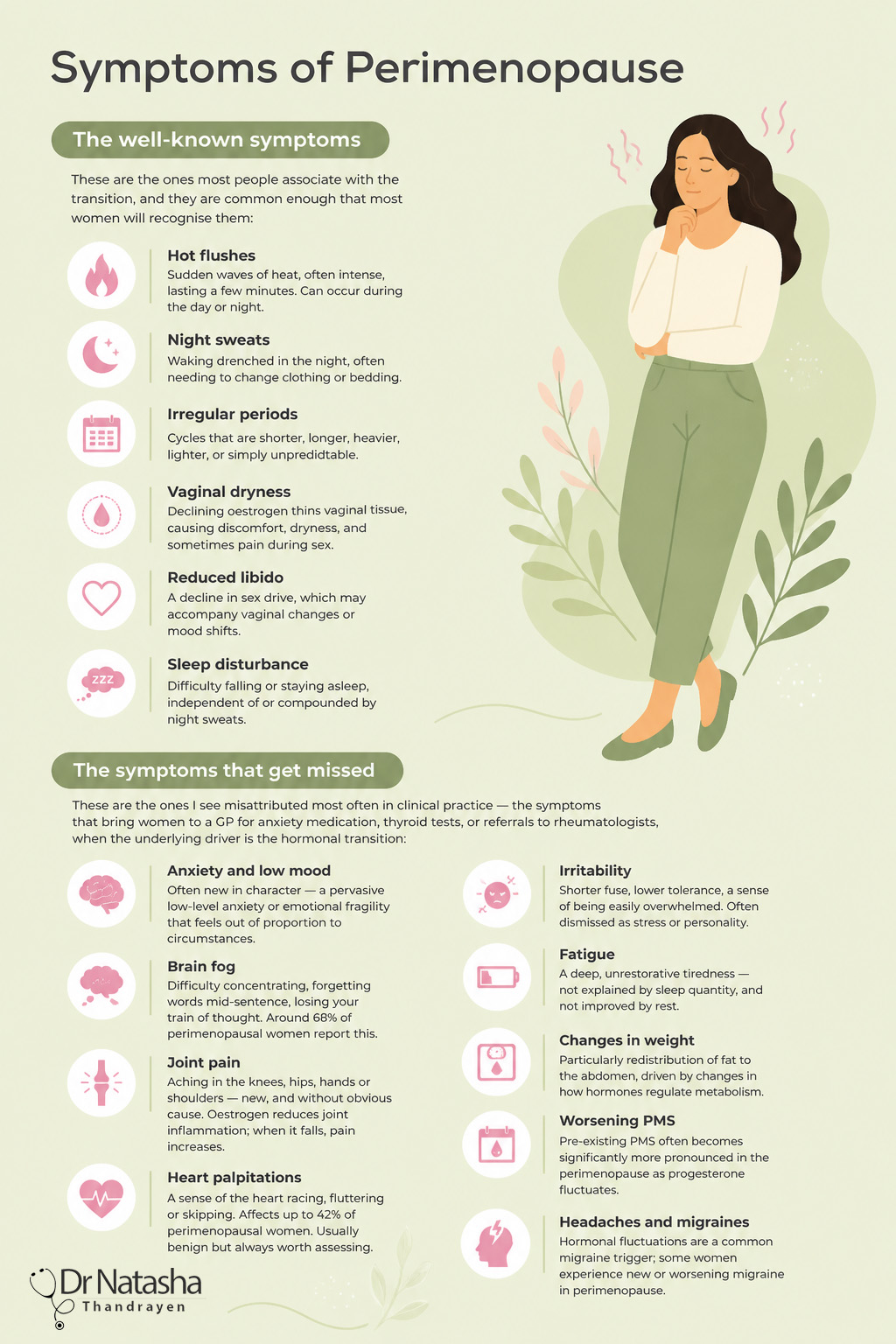
The honest answer is that it varies considerably. No two women experience perimenopause identically, and some women sail through with minimal disruption while others find it genuinely destabilising. What follows is a summary of what the evidence tells us — and what I see most regularly in clinical practice.
It is also worth noting that perimenopausal symptoms can vary between women of different ethnic backgrounds. Research suggests that vasomotor symptoms such as hot flushes may be experienced and reported at different rates and intensities across ethnic groups, and that psychological symptoms may also present differently. This variability is one of the reasons that a thorough, individualised assessment matters.
The well-known symptoms
These are the ones most commonly associated with the transition:
The symptoms that get missed
These are the symptoms I see misattributed most often in clinical practice — presenting as anxiety, fatigue, or joint pain, when the underlying driver is the hormonal transition:
The women I see in clinic who have spent the longest time without a clear explanation tend to share a similar pattern: anxiety without an obvious trigger, poor sleep, and a sense of not quite feeling themselves. Various avenues may have been explored — thyroid investigations, talking therapies, medication — sometimes with benefit, sometimes without. A hormonal assessment had not yet been part of the conversation, often because periods were still regular, or because the connection had not been made.
Why perimenopause is so often missed
There are several reasons, and they compound each other.
The first is that perimenopause is a clinical diagnosis, not a blood test. NICE guidance, updated in November 2024, is unambiguous: in women aged 45 and over, perimenopause should be identified on the basis of symptoms alone. Blood tests are explicitly not recommended for this age group, because oestrogen levels fluctuate so dramatically during the transition that a single measurement can fall within the normal range even during a symptomatic phase. A normal FSH or oestradiol result does not rule out perimenopause. It never has.
The second reason is the mental health overlap. A UCL meta-analysis published in 2024, covering 9,141 women across multiple countries, found that perimenopausal women are around 40% more likely to experience depression than premenopausal women. Anxiety, irritability, and low mood are some of the earliest and most common perimenopausal symptoms — yet they are also the symptoms most likely to be assessed without hormonal context. A Royal College of Psychiatrists survey found that three in four UK women do not know that menopause can trigger new mental health problems. Without that awareness, the hormonal contribution to mental health symptoms may not be explored in the way that it deserves to be.
If you have developed anxiety, low mood, or depression in your 40s — and it came on without an obvious cause, or has not responded as expected to treatment — it is worth considering whether perimenopause may be a contributing factor. These symptoms, in this age group, can be a direct hormonal effect, and may respond to hormonal assessment and management.
The third reason is the symptom scatter. Because oestrogen receptors are distributed across so many organ systems, the symptoms of perimenopause do not necessarily cluster in an obvious way. A woman might attend with joint pain, separately mention she is not sleeping well, and separately describe feeling anxious. None of those individual presentations may trigger a perimenopausal assessment. It is only when you take the time to consider the whole picture that the pattern becomes visible — and that requires a consultation of sufficient length and depth.
How is perimenopause diagnosed?
For women aged 45 and over, the diagnosis is clinical. That means a thorough conversation about symptoms, their timing, their character, their impact on daily life, and how they relate to any changes in the menstrual cycle. No blood test is required — or, per NICE guidance, recommended — for this age group.
For women aged 40 to 44 with symptoms, a blood test measuring FSH (follicle-stimulating hormone) may be used as a supporting tool, with the understanding that a normal result does not exclude perimenopause. For women under 40 where premature ovarian insufficiency is being considered, blood tests are an important part of the assessment.
If you are using hormonal contraception — including the combined pill or high-dose progestogen — FSH testing is unreliable. This is explicitly flagged in NICE guidance and is a frequent source of confusion. Hormonal contraception can mask the underlying hormonal picture, meaning the test result alone cannot be used to confirm or exclude perimenopause.
What are the treatment options?
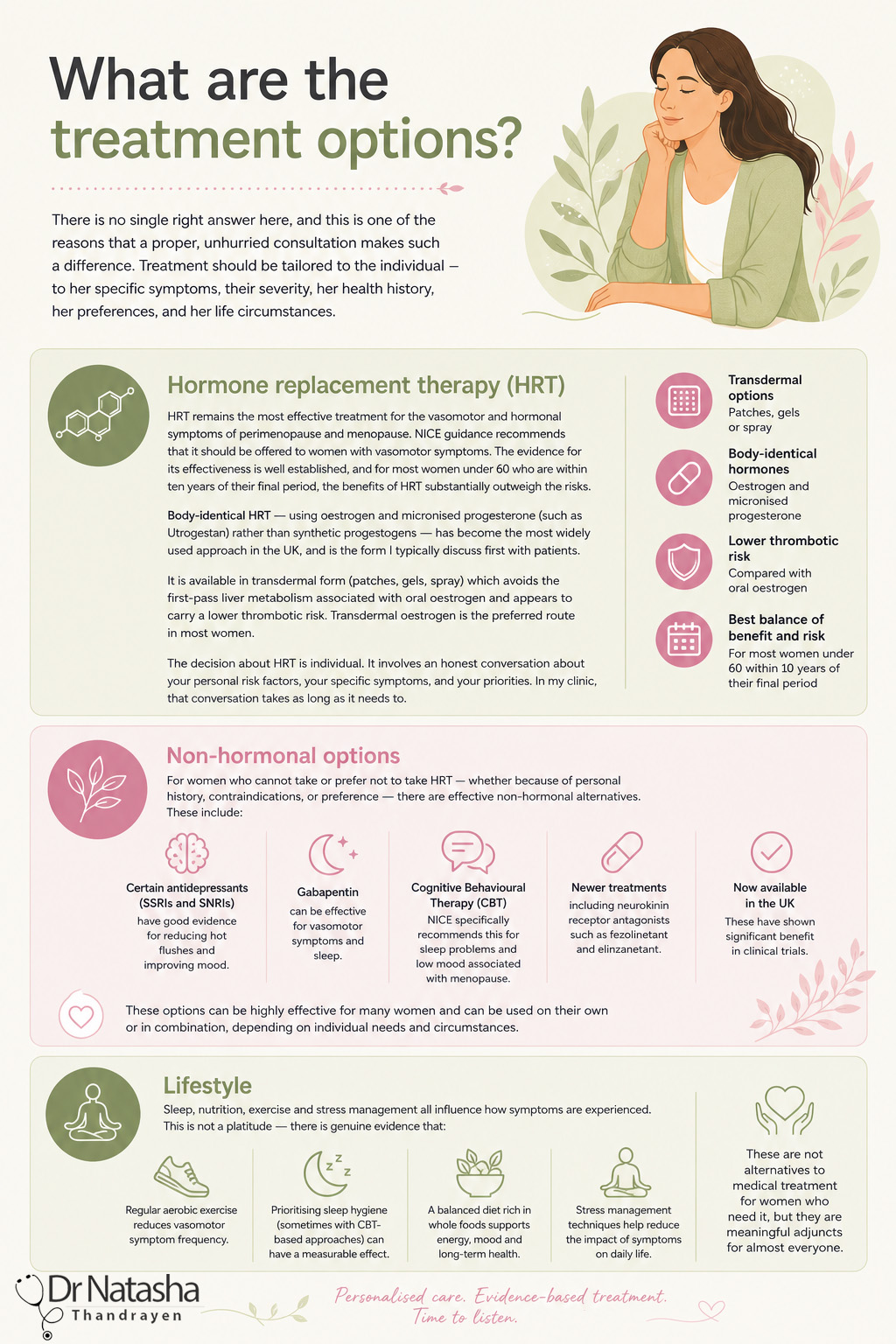
There is no single right answer, and this is one of the reasons that a proper, unhurried consultation makes such a difference. Treatment should be tailored to the individual — to her specific symptoms, their severity, her health history, her preferences, and her life circumstances.
Hormone replacement therapy (HRT)
HRT remains the most effective treatment for the vasomotor and hormonal symptoms of perimenopause and menopause. NICE guidance recommends that it should be offered to women with vasomotor symptoms. The evidence for its effectiveness is well established, and for most women under 60 who are within ten years of their final period, the benefits of HRT substantially outweigh the risks.
Body-identical HRT — using oestrogen and micronised progesterone (such as Utrogestan) rather than synthetic progestogens — has become the most widely used approach in the UK, and is the form I typically discuss first with patients. It is available in transdermal form (patches, gels, and spray) which avoids the first-pass liver metabolism associated with oral oestrogen and appears to carry a lower thrombotic risk. Transdermal oestrogen is the preferred route for most women.
The decision about HRT is individual. It involves an honest conversation about your personal risk factors, your specific symptoms, and your priorities. In my clinic, that conversation takes as long as it needs to.
Non-hormonal options
For women who cannot take or prefer not to take HRT — whether because of personal history, contraindications, or personal preference — there are effective non-hormonal alternatives. Certain antidepressants (SSRIs and SNRIs) have good evidence for reducing hot flushes and improving mood. Gabapentin can be effective for vasomotor symptoms and sleep. Cognitive Behavioural Therapy (CBT), which NICE specifically recommends for sleep problems and low mood associated with menopause, is an approach I am trained in and can discuss at consultation. Newer treatments — including neurokinin receptor antagonists such as fezolinetant and elinzanetant, both of which have shown significant benefit in clinical trials — are now available in the UK. These non-hormonal options can be highly effective for many women, and can be used individually or in combination depending on each person's needs.
Lifestyle
Sleep, nutrition, exercise, and stress management all influence how symptoms are experienced. There is genuine evidence that regular aerobic exercise reduces vasomotor symptom frequency, and that attending to sleep hygiene — sometimes with CBT-based approaches — can have a measurable effect. A balanced diet rich in whole foods supports energy, mood, and long-term health. These approaches are meaningful adjuncts for almost everyone, working alongside any medical treatment that may be appropriate.
"Professional, personable, thorough. I felt in excellent hands the whole time."
When a specialist is needed
For most women in perimenopause, a private GP with expertise and a particular interest in women's health is the right first port of call — someone who has the time to take a proper history, assess all the symptoms as a whole, and guide you through the treatment options without rushing. I am able to offer that at my clinic at Harley Street, and women's health is a particular area of my practice.
There are situations where onward referral to a specialist is the right step, however. Complex cases — premature ovarian insufficiency, severe or treatment-resistant symptoms, significant comorbidities or contraindications, cases where initial treatment has not produced the expected response — benefit from input at a specialist level. I know personally the leading gynaecologists and menopause specialists on Harley Street, and I refer to them without delay when the clinical picture calls for it.
When should you see a GP?
The honest answer is: sooner rather than later, and you do not need to wait until symptoms are severe. If you are in your 40s — or late 30s — and you have noticed any changes in your periods, new anxiety or low mood that feels different from your usual character, sleep that has deteriorated without an obvious explanation, fatigue that does not fit your circumstances, joint pain, brain fog, palpitations, or weight changes without a clear cause, worsening PMS, or simply a sense that something has shifted — a conversation with a GP is worthwhile.
You do not need a definitive list of symptoms ticked off before you seek help. You do not need your periods to have changed, or a blood test to have come back abnormal. What matters is that you have noticed something — and that you have the opportunity to discuss it properly with someone who will take the time to listen and consider the whole picture.
I would be very glad to help with that assessment. You can find out more about my women's health services — including perimenopause and HRT consultations — on the women's health page.
Book a perimenopause consultation
A 60-minute appointment at Harley Street with a GP who will take the time to listen, assess your symptoms properly, and discuss all your options with you. Always the same doctor, every appointment.
Book an Appointment 0207 935 1711Frequently asked questions
What age does perimenopause start?
Perimenopause most commonly starts in the mid-to-late 40s, though it can begin as early as the late 30s. The average age of the menopause in the UK is 51, meaning the perimenopausal transition typically begins in the mid-to-late 40s. Because early symptoms are often subtle and easily attributed to other causes, many women do not recognise what is happening for 12 months or more after symptoms first appear.
How long does perimenopause last?
The perimenopause transition typically lasts two to four years, ending one year after the final menstrual period. Vasomotor symptoms such as hot flushes and night sweats can persist for considerably longer, however — research suggests a median of around four years for these symptoms, with some women experiencing them for over a decade when the transition begins early.
Can a blood test confirm perimenopause?
Not reliably, for most women. NICE guidance, updated in November 2024, states that in women aged 45 and over, perimenopause should be diagnosed on the basis of symptoms alone — blood tests are not recommended. Oestrogen levels fluctuate so widely during the transition that a single FSH or oestradiol measurement can fall within the normal range even when symptoms are significant and the hormonal shift is clearly underway.
Blood tests are considered in women aged 40 to 44 with symptoms, and in women under 40 where premature ovarian insufficiency is being investigated. If you are using combined hormonal contraception, FSH testing is unreliable and cannot be used to confirm or exclude perimenopause.
Is my anxiety a symptom of perimenopause?
It may be. A UCL meta-analysis of 9,141 women, published in the Journal of Affective Disorders in 2024, found that perimenopausal women are around 40% more likely to experience depression than premenopausal women. Anxiety is one of the most common — and most commonly overlooked — perimenopausal symptoms.
A Royal College of Psychiatrists survey found that three in four UK women do not know that menopause can trigger new mental health problems. If you have developed anxiety or low mood in your 40s, particularly if it came on without a clear cause or has not responded fully to treatment, it is absolutely worth discussing perimenopause with a GP.
Can perimenopause cause brain fog and joint pain?
Yes. Both are well-recognised symptoms of perimenopause, though they are frequently attributed to ageing, stress, or separate conditions. Research suggests around 68% of perimenopausal women report brain fog, and up to 60% experience joint pain. Both are linked to declining and fluctuating oestrogen, which plays a role in cognitive function, joint lubrication, and the body's regulation of inflammation. If these symptoms are affecting your daily life, they are worth investigating.
What are the treatment options for perimenopause?
The main options are hormone replacement therapy (HRT), non-hormonal medications, and lifestyle approaches. NICE recommends that HRT be offered to women with vasomotor symptoms — it remains the most effective treatment for hormonal symptoms of the transition. Body-identical HRT using transdermal oestrogen and micronised progesterone is the most widely used approach in the UK.
Non-hormonal options include SSRIs, SNRIs, gabapentin, and newer neurokinin receptor antagonists such as fezolinetant. Cognitive Behavioural Therapy (CBT) is specifically recommended by NICE for sleep problems and low mood associated with menopause. The right approach depends on your symptoms, health history, and personal preferences — which is why a proper consultation is important.
When should I see a GP about perimenopause?
You do not need to wait until symptoms are severe. If you are in your 40s — or late 30s — and have noticed changes in your periods, mood, sleep, energy, concentration, or libido, a GP consultation is worthwhile. Equally, if you have been investigated and treated for anxiety, depression, or joint pain without a satisfying explanation or response, and you are in the relevant age range, it is worth discussing whether perimenopause may be a contributing factor. Early assessment means earlier access to treatment if you need it.
Can I be in perimenopause if my periods are still regular?
Yes. Perimenopause does not begin with irregular periods — it begins with hormonal fluctuation, which can be occurring for months or years before any change in the cycle is apparent. Symptoms such as worsening PMS, new anxiety, sleep disruption, or brain fog can all precede period changes. Regular periods do not rule out perimenopause, particularly if other symptoms are present.
What is the difference between perimenopause and menopause?
Perimenopause is the transitional phase leading up to the menopause — the years during which hormones are fluctuating and symptoms may be present, but periods have not yet stopped for 12 consecutive months. The menopause is defined as the point at which a woman has not had a period for 12 consecutive months. After that, she is described as postmenopausal. In everyday language the terms are often used interchangeably, but clinically they are distinct stages.